

The Story Starts Below!
The Jeans
The bathroom mirror was still fogged when Marcus stepped into the doorway.
He had my jeans in both hands, held up by the belt loops.
"You're dying," he said, quiet, not angry. "And you didn't tell me."
I stood there in my bra, one leg still half in my tights.
He looked at the jeans like they'd bit him.
"Marcus, it's Tuesday. I have to be at the garden center by eight."
The Doorway
He didn't move an inch, filling the frame in his work shirt.
KESSLER sat stitched over his chest pocket, crooked from years of washing.
I could see the jeans sagging between his fists, empty in a way they hadn't been in October.
"Look at these," he said. "Look at what's left of you."
I reached for my blouse on the hook behind the door.
He didn't hand the jeans over.
Kicked Loose
He didn't move from the door.
Instead he kicked the scale out from under the vanity with the side of his boot.
It skidded across the tile and stopped at my feet.
"Stand on it," he said.
Not a request. I stepped on just to end it, to get him out of my way so I could finish dressing and go to work like a normal person.
Waiting on the Number
The little screen flickered while it searched for weight, a habit of that old scale.
He crouched a little, watching it like it might lie to him.
"Come on," he muttered, not to me.
I crossed my arms over my bra strap, cold in the fogged air.
"You're scaring me more than any number is going to," I told him.
He didn't look up.
The Number
The scale blinked, then settled.
"128," he read out loud, like he didn't trust his own eyes.
He pulled his phone from his shirt pocket, thumbed to a note.
"October twenty-eighth. 166." He turned the screen toward me like proof in a courtroom.
"You've been logging me," I said. "Since October. Without telling me."
Since Christmas
"You think I wanted to?" he said, voice climbing now. "You think I liked doing this?"
He scrolled the note up, a column of dates and numbers going back months.
"December, January, February," he said, tapping each one. "It's not slowing down, Sloane."
I stared at the little black numbers, my own body turned into a spreadsheet.
"Why didn't you just ask me?" I said.
What People Do
"Somebody's hiding lab results," he said. "Somebody's protecting the other person."
His voice cracked on protecting.
"That's what people do, Sloane. That's what people do to each other."
"I eat the same," I said. "I live the same. Nothing has changed."
He shook his head like the words didn't land anywhere.
I said it again, slower. "Nothing has changed, Marcus."
Not Landing
"Then where did thirty-eight pounds go," he said, and his hand shook on the phone.
"I don't know," I said. "That's the truth. I don't know."
"You'd tell me if you knew," he said. "Wouldn't you. You'd actually tell me."
Something in the way he asked it stopped me cold in the doorway.
"Yes," I said. "Would you tell me?"
Four Times in Twenty-Two Years
His eyes went wet before I understood what was happening.
I have seen my husband cry four times in twenty-two years of marriage.
This made five, standing in a doorway holding my old jeans.
Then something in his face closed, fast, like a door swinging shut on its own weight.
"A scan," he said, flat now. "That'll settle it."
The Closing
I watched the wet leave his eyes like someone had turned off a tap.
"Marcus," I said. "Talk to me. Actually talk to me."
"I said a scan," he repeated, and set the jeans down on the sink edge.
He wiped his face fast with the back of his wrist, once, done.
"That's the only thing that's going to settle this," he said again.
Her Terms
I took the phone right out of his hand.
He let me, which scared me more than if he'd fought for it.
I opened the insurance app, found a neurology referral, booked it for the following week.
"On my insurance," I said. "My terms. And you're going to owe me an apology. In writing."
He didn't answer that.
What He Watched Instead
I held the confirmation screen up so he'd see the date, the time, the doctor's name.
"Bhatt," I read out. "Next Tuesday. Nine a.m. You're coming."
He looked at it like it was a summons, not an appointment.
"I'll come," he said, quiet again.
"That's not the apology part," I said.
Don't Make Me Watch It Twice
He backed into the hallway, wouldn't look at me straight on.
"Don't make me watch it twice," he said, low, almost to the wall.
I opened my mouth to ask him what that even meant.
He was already walking toward the kitchen, boots loud on the hardwood.
I stood there holding his phone, the scan booked, the question hanging in the fogged mirror behind me.
Finishing Dressing
I pulled my blouse on with my hands not quite steady.
Twice, he'd said, like this had already happened to him once before.
I buttoned wrong and had to start the top button over.
Down the hall I heard the coffee maker gurgle, then stop, then nothing.
I stepped into the jeans he'd held up, and they slid on loose as a robe.
Down the Hall
I found him at the counter, not drinking the coffee he'd poured.
His shoulders were up near his ears, like he was bracing for weather.
"You called Rhonda," I said, not a question, just laying it out.
He didn't turn around.
"It was early," he said. "She was already up."
The Smoothie
Nell knocked twice on the open door, a glass in her hand.
"You look thin, Mom," she said, holding it out. "I made you one."
I took it, still in my bra, still confused, still holding his phone.
Behind her the truck door slammed in the driveway.
The engine turned over, rough, then caught.
Nell's Face
Nell's eyes went from me to her father's back at the counter.
Something crossed her face too fast for me to name it.
"Is everything okay?" she asked, and looked at him, not me.
"Your mother's got a doctor's appointment," Marcus said, still not turning around.
"Good," Nell said, too quickly, and went to get her own bag.
Out the Door
Marcus grabbed his keys off the hook without saying goodbye to either of us.
He paused at the door, hand on the frame, back still to me.
"Tuesday," he said. "Nine o'clock. I'll be there."
"You'd better be," I said. "In writing, Marcus. I mean it."
He didn't answer, just went out into the cold driveway.
The Cupholder
I followed him as far as the porch, his phone still warm in my hand.
He didn't ask for it back, just held his palm out at the truck window.
I dropped it into the cupholder instead of his hand, so I could look one more time.
The screen was still lit from his last call.
Rhonda, five-oh-four a.m., three minutes long, before any of this had even started.
What I Saw
Before I handed the phone back I glanced at the call log, out of habit.
One number sat at the top, five-oh-four that morning.
Rhonda. His sister in Zanesville, a woman he called maybe twice a year.
Five in the morning, before I was even awake, before the jeans, before any of this.
I put the phone in his truck cupholder and never asked him why.
The Waiting Room
Marcus filled out my intake form at a clipboard by the window.
I sat across from him, still tired from a week of waiting for this.
"Family history," he said, half to himself, pen moving fast.
He didn't ask me a single question the whole time.
I didn't think anything of it, just watched his hand move across the page.
Small Talk
A woman two chairs down coughed into her elbow and apologized to no one.
Marcus kept writing, his knee bouncing under the clipboard.
"You want coffee?" he asked, not looking up. "From the machine."
"I'm fine," I said, though my mouth was dry as paper.
He nodded and kept writing, and I let the silence sit between us like something ordinary.
Called Back
A nurse called my name and we followed her down a hallway that smelled like hand sanitizer.
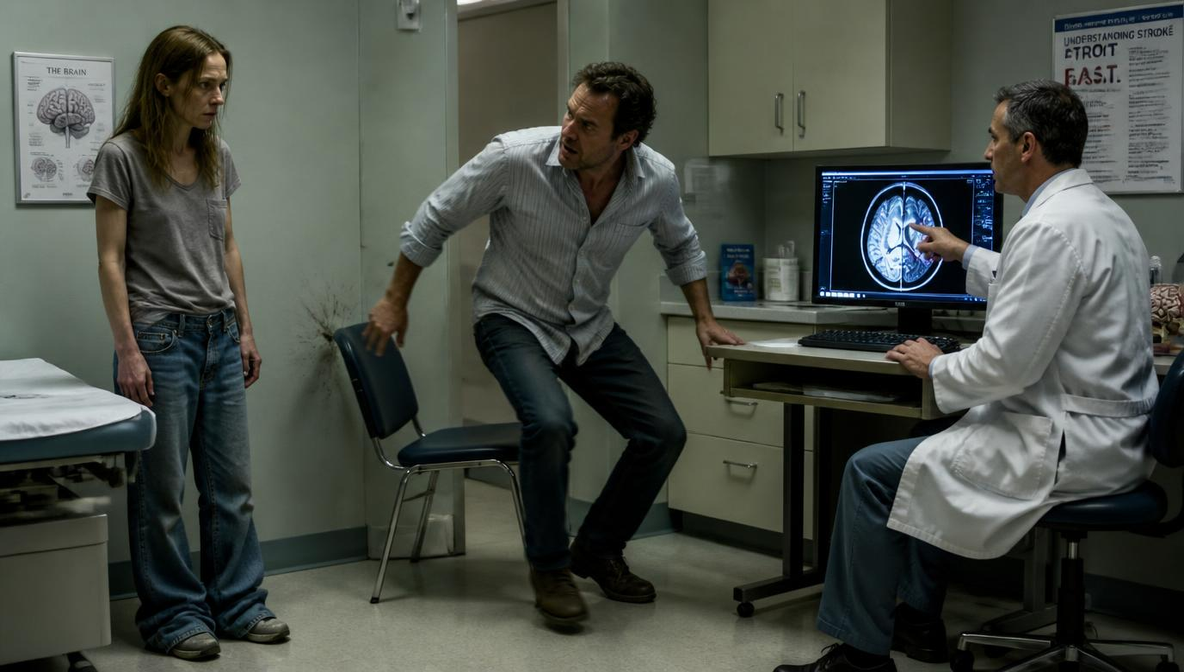
Dr. Bhatt's office had a light box on the wall, already loaded with images.
He was younger than I expected, glasses pushed up on his head.
"Mrs. Kessler," he said, shaking my hand first, then Marcus's.
Marcus sat in the chair behind me, close enough that I could feel him breathing.
Settling In
Bhatt pulled the clipboard from Marcus and scanned it fast, nodding to himself.
"Thirty-eight pounds since October," he read out. "That's a lot in five months."
"That's what I've been telling him," I said, tilting my head at Marcus.
Marcus didn't answer, just shifted his boots under the chair, laces still dirty from a job site.
Bhatt set the clipboard down and turned to the light box behind him.
The Images
Bhatt clicked through gray shapes on the screen, narrating like a tour guide.
"This is normal tissue here," he said, pointing with a pen. "And here, and here."
I nodded along, not understanding most of it, just wanting an answer.
Marcus said nothing behind me, his chair creaking once when he shifted his weight.
I reached back without looking and found his knee, just to feel him there.
His Hand Under Mine
His knee was tight as a fist under my palm.
I glanced back once, quick, and his eyes were fixed on the screen, not on me.
Something in his jaw had gone hard, the muscle working under the skin.
I turned back around, told myself it was just worry, the same worry I had.
Bhatt kept talking, his pen tracing shapes I couldn't read.
Four Words
"Given the pattern here," Bhatt said, "we'd normally want to rule out something hereditary, specifically Hun-"
The chair hit the wall before he finished the word.
Marcus was already standing, the metal legs scraping hard against the floor.
He didn't look at me, didn't look at the screen, just turned for the door.
"Marcus," I said, but he was already in the hallway, footsteps fast and uneven.
The Door Swinging
The door swung twice on its hinge before it settled shut.
I half rose out of my seat, one hand still on the arm of the chair.
Bhatt's pen hung in the air, pointed at a screen nobody was looking at anymore.
Down the hall a cart rattled, someone's laugh, ordinary hospital sounds going on without us.
I sat back down slow, my legs not quite steady under me.
Empty Chair
Bhatt stopped talking, pen still raised toward the screen.
"Is he all right?" he asked, looking at the door instead of me.
"I don't know," I said, which was starting to feel like the only true thing I owned.
I stood halfway up, torn between chasing him and staying for whatever came next.
Bhatt set his pen down. "Take a minute," he said. "I'll wait."
Trying His Phone
I texted Marcus from the exam room, my thumbs clumsy on the screen.
Where are you. Come back. I need you here.
No dots appeared, no answer, nothing.
I called once and it rang four times before it went to voicemail.
I set my phone face down on my knee and told Bhatt to go on.
Bhatt Waiting
Bhatt watched me for a second, patient in a way that felt practiced.
"Take your time," he said again. "There's no rush on my end."
I looked at the closed door one more time, willing it to open.
It didn't.
"Go on," I said finally. "Please. Tell me what you were going to say."
What Comes Next
"I want to finish explaining what we're looking at," Bhatt said, gentler now.
"Whatever he heard," I said, "he heard before you got to the important part."
Bhatt nodded slowly, like he understood something I didn't yet.
"There's a hereditary condition we always check for first," he said. "I want you to know we ruled it out fast."
I didn't understand yet why that word alone had emptied the room.
The Real Finding
"What we actually found," Bhatt said, turning back to the screen, "is a growth. Here, on the pituitary stalk."
He circled it with a grease pencil, twice, the wax squeaking on the glossy paper.
"It's rare," he said, "but it explains the weight loss. It's very likely operable."
I stared at the two circles, small and neat, sitting where my whole panic had been aimed.
"Operable," I said, testing the word like it might not hold my weight.
What He Explained
"It runs your metabolism ragged," Bhatt said. "Like a furnace nobody shut off."
"So I'm not dying," I said, needing to hear him say it plain.
"Not from this," he said. "We'll get you scheduled with a specialist to talk options."
I nodded, my eyes still on the two circles, my chest loosening for the first time in a week.
Then it tightened right back up, because Marcus wasn't there to hear any of it.
The Printout
Bhatt pulled the still from the printer tray and handed it to me.
"Keep this," he said. "For your file, or just for yourself."
I folded it once, careful not to smudge the pencil marks, and slid it into my purse.
It would live there for weeks, a small flat proof of the morning everything cracked open.
I thanked him, though thank you felt like the wrong shape for what I was feeling.
The Family History Box
"One thing," Bhatt said, flipping back to my intake form. "Your husband wrote none here, under family history."
He turned the clipboard so I could see it, his handwriting square and fast.
"Is that accurate?" Bhatt asked. "Because that reaction wasn't nothing."
"I don't know what's accurate," I said. "He filled that out himself. In the waiting room. This morning."
Bhatt looked at me for a second too long, like he was deciding what to say next.
Reading His Own Writing
I stared at the word none, small and hard in his fast handwriting.
It didn't look like a guess. It looked like a decision.
"He wrote that this morning," I said again, quieter, mostly to myself.
Bhatt didn't push, just set the clipboard down between us on the little rolling table.
The word sat there, four letters doing more damage than anything on the screen had.
Bhatt's Question
"Does your husband have a family history of Huntington's disease?" he asked, plain, no circling around it.
I opened my mouth and nothing came out for a second.
"I've never heard that word in my house," I said. "Not once, in twenty-two years."
Bhatt wrote something down, unreadable from where I sat.
"That's unusual," he said, "for a reaction like that," and left it hanging there.
Gathering Myself
I picked up my purse, the folded printout heavy inside it now.
"Thank you," I said again, and this time it came out steadier.
Bhatt walked me to the door himself, his hand light on my shoulder.
"Call the office if you have questions," he said. "Any time."
I nodded and stepped into the hallway, already scanning for a white truck through the far window.
Down the Hallway
I walked out past the nurse's station, purse heavy with the folded printout.
The waiting room chairs sat empty except for a mother reading to a toddler.
No Marcus on the bench by the window, no Marcus by the vending machines.
I checked my phone again, nothing, just my own last text sitting unanswered.
I told myself he'd gone to warm up the truck, nothing more than that.
The Parking Lot
I pushed through the glass doors into a wind that cut through my coat.
Rows of cars sat under a gray sky, none of them his white truck.
I walked the whole lot once, twice, my keys cold in my hand.
I called him again, listened to it ring out, listened to his voice tell me to leave a message.
He wasn't there. He hadn't waited. He hadn't come back to hear the rest of it.
No Truck at the Curb
I called Nell from the parking lot, my voice tighter than I meant it to be.
"Dad's not here," I said. "He walked out during the appointment."
She was quiet a second. "He does that," she said. "Sometimes."
I asked her what that meant, but she said she had class and hung up before I could push.
I stood there with my phone in my hand, more confused than before I'd called.
Standing in the Cold
I stayed by the car a minute longer, the wind cutting through my coat.
A man walked past pushing a woman in a wheelchair toward the entrance.
I watched them go, thinking how simple their trouble looked from where I stood.
My own trouble felt like a locked box I hadn't found the key for yet.
I got in my car and sat there before I even started the engine.
Driving Home Alone
I drove home with the printout riding in my purse on the passenger seat.
The house was dark when I pulled in, no truck in the driveway.
I let myself in, made tea I didn't drink, and waited at the kitchen table.
Nine o'clock became eleven, then midnight, then one in the morning.
I texted him twice more, short and plain. Where are you. I'm not angry.
The Long Hours
I sat with the printout in front of me, the two pencil circles staring up.
I tried Bhatt's word in my head, the one the chair had cut off.
It started with an H. I couldn't make myself finish it either.
I thought about calling Rhonda but didn't have her number saved, only his did.
I put my phone face down on the table and watched the clock instead.
The Truck at Two
Headlights swept the living room wall a little after two in the morning.
I heard the engine cut off outside, then nothing, no door opening.
I went to the window and saw him sitting in the cab, lights off now.
He didn't come in. He just sat there, hands still on the wheel.
I pulled my coat over my nightgown and walked out into the cold.
Crossing the Driveway
The concrete was cold through my socks, no time to find shoes.
I could see the shape of him through the windshield, not moving at all.
For a second I thought about knocking on the glass instead of opening the door.
I didn't. I just walked around to the passenger side like I had a right to.
The handle was cold enough to sting my palm when I pulled it.
Getting In
The passenger door was unlocked, and I climbed up into the seat beside him.
He didn't look at me, just kept his eyes on the garage door.
"You left," I said. "In the middle of it. You just left."
"I know," he said, voice flat and tired. "I couldn't sit there."
The cab smelled like gas station coffee and something else, something like a long drive.
Where He'd Been
"You've been gone since the appointment," I said. "That's not a walk around the block."
He rubbed his face with one hand, dragging it down slow.
"I had to think," he said. "I got in the truck and I just drove."
"To Zanesville," I said, guessing, watching his hands tighten on the wheel.
He didn't answer that, which told me more than any answer would have.
The Console
I reached down out of habit to close the console lid between us.
Something crinkled under my hand, paper caught at an odd angle.
I pulled it loose without thinking, just clearing space, and found a receipt.
Zanesville Marathon, it said, stamped eleven forty-two p.m., dated two days ago.
Under it sat a small card, glossy, the corner bent from being wedged in tight.
The Card
I held it up toward the dome light so I could read it.
A woman's photo, thin, silver-haired, with eyes I'd know anywhere on his face.
Dorothy Kessler, it read. Nineteen forty-nine to two thousand three.
"Marcus," I said. "This is your mother's memorial card. From her funeral."
He finally turned his head and looked at it like it had bitten him too.
What He Said First
"She didn't have Alzheimer's," he said, before I could even ask a question.
I stared at him, the card still warm between my fingers from the light.
"You told me she did," I said. "Twenty-two years, Marcus. You told everyone that."
"I know what I told you," he said, and looked back out the windshield.
His jaw worked once, hard, the same way it had in Bhatt's office.
Sitting With That
I turned the card over, looking for anything else printed on the back.
There was nothing, just a small printed prayer, ordinary words for an ordinary death.
"Twenty-two years," I said again, quieter this time, mostly to myself.
He didn't move, didn't reach for me, just kept his hands on the wheel.
The dome light buzzed faintly above us, the only sound in the cab.
Asking for the Truth
"Then what did she have?" I said. "Just say the word, Marcus."
He shook his head slow, both hands still gripping the wheel.
"Not tonight," he said. "Not until we know what's wrong with you first."
"Something is wrong with your mother's death," I said. "That's already true."
He didn't answer that, just stared straight ahead like the garage door might move.
Pushing Once More
"You don't get to trade one truth for another," I said. "That's not how this works."
"I'm not trading," he said. "I'm asking for a week. Maybe less."
"You asked me to trust you this morning," I said. "Look how that went."
He flinched at that, small, like I'd landed a hit I hadn't meant to aim.
"I know," he said. "I know how it looked. I still need the week."
The Town
"Where did she die," I said. "Not the story. The real place."
He was quiet long enough that I thought he wouldn't answer at all.
"Zanesville," he said finally. "A nursing home there. Cedar Ridge. Rhonda found it for her."
"That's where you go," I said. "Those late nights. Those training trips."
He didn't confirm it, but he didn't deny it either, which felt the same.
Cedar Ridge
"How long was she there," I asked. "Before she died."
"Almost three years," he said. "Toward the end she didn't know who I was."
I tried to picture him young, driving down there alone, no one to tell.
"Why didn't you ever bring me," I said. "Not once, in all that time."
"Because you would have asked questions," he said. "The kind you're asking now."
Reaching for the Card
I held the memorial card out a little, still turned toward the dome light.
"I want to keep this," I said. "In case you disappear again."
He reached over and took it gently out of my fingers instead.
"Not yet," he said. "Please. Not until we're done with your scans."
He tucked it back into the console, under the receipt, out of my reach.
The Silence After
I let my hand fall back into my lap, empty now, cold.
Neither of us said anything for a minute, the garage door lit faint by streetlight.
I thought about getting out, going back inside, letting him sit alone.
Instead I stayed, because some part of me still wanted the rest of it.
"You said you'd answer anything," I reminded him. "After my diagnosis is settled."
What He Owed Me
"I did say that," he admitted, low, almost swallowed by the quiet cab.
"So I'm holding you to it," I said. "Every word, when this is done."
He nodded once, barely, like agreeing cost him something physical.
"Fine," he said. "When it's settled. I'll tell you whatever you ask."
I didn't believe him completely, but I let the words sit between us anyway.
The Last Question
"Have you ever been tested," I said. "For whatever this is. Yes or no."
He didn't look at me. He looked at the ignition instead.
"Sloane," he said, and stopped, like the rest wouldn't come out right.
The silence sat there long enough that I thought maybe that was his answer.
Then he turned the key, and the engine caught loud in the quiet driveway.
Zanesville
I told Marcus I was going to see Rhonda before he left for work.
He stopped in the kitchen doorway, coffee halfway to his mouth.
"That's not a good idea," he said. "Not yet. Not before your surgery is even scheduled."
"I'm not asking your permission," I said, and picked up my keys off the counter.
He set the mug down hard enough that coffee jumped over the rim.
Getting Ready
He followed me to the door, boots half laced, one hand on the frame.
"You don't even know what you're walking into," he said. "Let me come with you."
"You had your chance in the truck," I said. "You gave me a nursing home name."
"That's not nothing," he said, and I laughed, short and not kind.
I grabbed my coat off the hook and left him standing in the hallway.
The Drive
The road to Zanesville took an hour and ten minutes, mostly flat farmland.
I kept the memorial card image in my head the whole way there.
Dorothy's eyes, Marcus's eyes, staring out from a photo I'd only seen once.
I rehearsed questions out loud in the car, trying to sound calm.
By the time I pulled into Rhonda's driveway, I didn't feel calm at all.
Sitting in the Car
I sat a minute before going in, my hands still on the wheel.
The house was small and neat, a wreath still hanging from last fall.
I thought about turning around, about how much I still didn't want to know.
Then I thought about Marcus's face in the truck, the way he'd flinched.
I got out before I could talk myself back into the car.
Rhonda's Kitchen
Rhonda answered the door in a cardigan with flour on one sleeve.
"I wondered when you'd show up," she said, stepping back to let me in.
Her kitchen smelled like coffee cake, warm and ordinary, nothing like what I'd come for.
She poured me a cup without asking and set it down hard.
"Sit," she said. "You've got questions. I can see it on your face."
Before the Folder
She sat down across from me, folding her hands like she was bracing.
"He called me," she said. "This morning. Told me you might come by."
"And what did he tell you to say," I asked, not bothering to soften it.
Rhonda gave a small, tired laugh. "Nothing. He just sounded scared, Sloane."
"He's not the only one," I said, and she nodded like that landed.
The Program
Rhonda went to a drawer by the fridge and pulled out a folder.
Inside was a program, folded once, yellowed a little at the edges.
"Marcus handled the printing," she said. "I never even saw the words until later."
She slid it across the table and tapped the bottom line with one finger.
In lieu of flowers, Huntington's Disease Society of America, it read, plain as that.
Saying It Out Loud
"That's the word," I said. "The one the doctor started to say."
Rhonda nodded, her mouth tight, like the word cost her something to hear.
"Our mother had it," she said. "Our grandfather had it before her. It runs in families."
"Fifty-fifty," she added, before I could ask. "Every kid of hers had those odds."
I looked at the program again, the letters small and plain and final.
What I Didn't See
"I went to that funeral," I said. "I stood at that grave, Rhonda."
"I know," she said, not meeting my eyes now. "He kept you away from the details."
"I signed the guest book," I said. "I thought I knew what we buried."
"You knew what he let you know," she said, and pushed the folder closer.
I ran my thumb over the fold, over words I'd never been shown before.
The Photograph
She reached into the folder again and pulled out an old photo.
A man stood stiff in a suit, eyes exactly like Dorothy's, exactly like Marcus's.
"Our grandfather," she said. "Nobody talked about him either. Not until Mom got sick."
"I never got tested," she said. "I didn't want to know. Marcus didn't either."
I set my coffee down, my hands not quite steady on the table.
Asking Straight
"Did he ever get tested," I said. "You'd know. You're his sister."
Rhonda picked at the edge of the photo instead of answering right away.
"That's his to tell you," she said. "Not mine. I've already said too much."
"You've said almost nothing," I said. "I'm asking you to just say it."
She looked at me a long second, like weighing what she owed me.
The Slip
"So he never got tested," I said, watching her face for the truth.
Rhonda's mouth opened, then closed, like she'd caught herself before saying too much.
"After he got his results," she started, then stopped hard, like a door shutting.
"He didn't call me for a year," she said finally. "Not one phone call."
I sat very still, because that sentence didn't sound like grief at all.
Catching It
"You said results," I said. "Like there's a test somewhere with his name on it."
Rhonda's face went pale, like she'd only just heard herself say it out loud.
"I misspoke," she said, too fast, reaching for her coffee cup with both hands.
"You didn't," I said. "You don't misspeak a whole year of silence, Rhonda."
She set the cup down without drinking from it, staring at the table.
The Phone Rings
Rhonda's phone buzzed on the counter before I could ask another question.
She looked at the screen, then at me, her face going careful.
"It's Marcus," she said, and answered it on speaker without asking me first.
"Rhonda," his voice came through, tight and fast. "Is Sloane's car in your driveway?"
"She's sitting right here," Rhonda said. "Drinking my coffee. Asking about Mom."
What He Told Her
"Don't tell her anything else," Marcus said, his voice loud in the small kitchen.
"Whatever you already said, that's it. Nothing more. You hear me, Rhonda?"
Rhonda glanced at me, apology already forming on her face before she spoke.
"She's a grown woman, Marcus," she said. "She's not a kid you can manage."
"I mean it," he said, and the line went dead before she could answer.
After the Call
Rhonda set the phone face down on the table, her hand shaking a little.
"He's never talked to me like that," she said. "Not once, in years."
"He's scared," I said, "of what you already almost told me without meaning to."
"I know," she said. "I just watched him fall apart on the phone."
She looked at the program between us like it was suddenly too heavy.
The Year
Rhonda set the phone face down, her hand not quite steady either now.
"He got his results in 2004," she said, quiet, like it slipped out sideways.
"That's the year he didn't call me. Not once. Not even at Christmas."
I sat with that year turning over in my head, looking for its shape.
2004 was the year Marcus took me to Niagara Falls for our anniversary.
The Best Year
I remembered it clear, him laughing on that boat in the yellow rain slicker.
I remembered him holding my hand at the railing, water roaring below us.
I had called that our best year for almost two decades without knowing why.
Now it sat across the table from me, folded inside a stranger's silence.
Rhonda watched my face change and reached for the program to take it back.
Twelve Days
Twelve days since the exam room, and Marcus still hadn't asked what the scan showed.
He'd asked if I was tired, if I needed anything from the store.
He never once asked the actual words.
I started noticing it like a missing step on the stairs, small at first.
By day ten I was counting the silence on purpose, keeping score in my head.
Small Talk Instead
He asked about the garden center, about a shipment of mulch that came in late.
He asked if Nell had called, if the truck needed an oil change soon.
Every question skirted the edge of the one that mattered most.
I answered him each time, waiting for him to circle back to my body.
He never circled back. He just kept walking the long way around it.
The Recording
My phone still had the voice memo from that morning, forty-one minutes long.
I record every appointment, a habit left over from my mother's last year of doctors.
I'd forgotten it was even running until I scrolled past it looking for something else.
I sat at the kitchen table and stared at the little waveform, unplayed.
Something told me I needed to hear it before I said another word to him.
Deciding
I thought about playing it alone first, just to know what I'd be handing him.
Then I thought about all the things he'd handled alone, without me in the room.
I put the phone face down on the table and left it there.
I wanted him sitting across from me when the words finally came out.
I wanted to watch his face while he heard the sentence he'd run from.
Waiting for Him
I waited until his truck pulled in that evening, later than usual.
He came through the door with his hands still black from a job site.
"Long one," he said, heading for the sink to scrub up.
"Sit down first," I said. "Before you wash. I need you to hear something."
He looked at my face and stopped moving toward the water.
His Face at the Table
He wiped his hands on his jeans instead and dropped into the chair across from me.
"Is it bad news," he said, quieter than I expected. "Is that what this is."
"Just listen," I said. "All the way through. Don't get up."
He nodded, though his knee had already started bouncing under the table.
I set the phone down between us, screen up, waiting.
Setting the Phone Down
I set the phone on the table between us, screen up, waiting.
"What is this," he said, not touching it, his hands still dirty at his sides.
"The appointment," I said. "All of it. I recorded it, like I always do."
He sat down slow, like the chair might not hold him.
I hit play before he could ask me not to.
Bhatt's Voice
Bhatt's voice came out tinny through the small speaker, calm and clear.
"Given the pattern here, we'd normally want to rule out something hereditary, specifically Hun-"
The recording caught the scrape of the chair, loud, right on cue.
Marcus's jaw tightened at the sound of his own chair hitting the wall.
I didn't pause it. I let it keep running past the moment he'd left.
The Empty Room
The recording caught footsteps too, fast and uneven, fading down the hallway.
Then Bhatt's voice again, softer, asking if I wanted a minute before he continued.
My own recorded voice answered, small and tired, telling him to go on.
Marcus sat still, listening to a version of that morning he had never heard.
His hands stayed flat on the table like he was holding it down.
The Twelve Seconds
The room on the recording went quiet for a few seconds, just breathing, just Bhatt's pen.
Then his voice again, steady. "We ruled that out fast. This is not that."
I watched Marcus's face when he heard it, watched it not change fast enough.
"That's the part you never heard," I said. "Because you were already gone."
He stared at the phone like it had said something impossible.
Not Dying
Bhatt's voice kept going, explaining the growth, the pituitary stalk, the word operable.
I let it play until the end, until his own voice thanked me and said goodbye.
Then I reached over and stopped it, the kitchen suddenly too quiet.
"I'm not dying," I said. "I have a growth. It's fixable. That's the whole thing."
Marcus didn't move, didn't reach for me, didn't say a single word of relief.
Waiting for Something
I waited for him to smile, to reach across the table, to say thank God.
The fridge hummed behind him, the only sound filling the space he left empty.
"Did you hear me," I said. "Marcus. It's operable. I'm going to be fine."
He looked at the phone, not at me, his mouth working without any sound coming out.
Something in his silence felt heavier than any relief I'd expected from him.
What He Said Instead
"Then it's me," he said, so quiet I almost missed it under the fridge hum.
"What are you talking about," I said. "Marcus, look at me. I'm okay."
He put his black hands flat on the table, not looking up at all.
"You heard the doctor," he said. "That word. That's not about you. It's about me."
I sat very still, waiting for him to say the rest of it himself.
2004
"I've known since 2004," he said, and the year landed like something dropped.
Niagara Falls, the yellow slicker, the boat, all of it rearranging itself in my head.
"You got tested," I said. "That's what Rhonda meant. That's the year she meant."
He nodded once, still not looking up from his own dirty hands.
"I've been positive nineteen years," he said. "And I never told you a single day of it."
Sitting With It
I didn't reach for him, didn't say I was sorry, didn't say anything at all.
Twelve days of silence made sense now, all lined up in a row.
He hadn't asked what I had because he wasn't listening for me.
He'd been listening for himself the whole time, in a room meant for my body.
"Twelve days," I said finally. "You never once asked what was wrong with me."
His Answer
"I knew you'd be fine," he said. "I could tell by how you were talking."
"You didn't know that," I said. "You didn't ask. There's a difference, Marcus."
He finally looked up, his eyes wet the way they'd been in the bathroom weeks ago.
"I was drowning," he said. "In my own thing. I didn't have room for yours."
I felt something in my chest go cold and clear at the same time.
What I Wanted to Say
I wanted to tell him twelve days of silence had felt like being invisible.
I wanted to ask if he'd rehearsed how long he could keep this from me.
Instead I just watched his hands, still black at the knuckles, still shaking a little.
"Say it again," I said. "Say the year again. I want to hear it clean."
"2004," he said, and this time his voice didn't waver at all.
The Negotiation Starts
"So now you know," he said, wiping his face with the back of his wrist.
"Now what," I said. "You said you'd tell me everything once mine was settled."
"It's settled," he said. "You heard the doctor. It's not that. It's operable."
"Then start talking," I said. "All of it. Right now, at this table."
He nodded slow, like he was already deciding what to leave out.
What He Gave Me
"I'll tell you everything," he said. "The clinic, the letter, all of it."
"Tonight," I said. "Not next week. Not after some appointment you haven't scheduled yet."
"Tonight," he agreed, and something in his shoulders dropped like a weight coming off.
For a second I almost believed the worst of it was over, sitting right there.
Then his face changed again, careful now, like he was building toward something.
Before He Went On
He stood up like he meant to get the box right then, hands still on the table.
Then he sat back down, slow, like the words needed one more second.
"There's a letter," he said. "And other things. Nineteen years of other things."
"Then let's see them," I said, though something in his face made me wait.
He looked at me the way he had in the bathroom, like he owed me a debt.
The Condition
"There's one thing," he said. "Before I show you anything else in that box."
"What," I said, already bracing for it, already knowing his voice too well.
"Nell can't know yet," he said. "Not until I say she can know."
"She's twenty-one," I said. "Not a kid you get to manage forever, Marcus."
"I mean it," he said. "I need that from you. I'm not asking."
The Garage Door
Marcus stood up from the table, his knee still bouncing from the fight in it.
"Come on," he said. "You want the box, you get the box tonight."
I followed him through the mudroom into the garage, cold air hitting my arms.
He clicked on the bare bulb over his workbench, yellow and buzzing.
Above us the crawlspace hatch sat dark, a square cut into the ceiling.
Before the Ladder
He stood under the hatch a second, not moving, both hands on his hips.
"You sure you want this tonight," he said. "It doesn't go back in the box after."
"You already told me the year," I said. "There's no going back from that either."
He looked at me like he was hoping I'd change my mind for him.
I didn't. I just waited for him to drag the ladder over.
The Ladder
He dragged the metal step ladder over and set it under the hatch.
"You go up," he said. "I'm not climbing tonight. My knees are shot."
I climbed the rungs slow, my hand finding the cold edge of the hatch.
Inside was dark and smelled like insulation and old cardboard.
"There's a flashlight clipped to the beam," he said. "Left side, past the vent."
Finding the Box
I found the flashlight, then the box, small and gray, heavier than it looked.
My knees pressed into the joists, dust in the beam of light.
I passed it down to him first, then climbed down after it myself.
He set it on the workbench between us, under the buzzing bulb.
"Open it," he said. "I'm not doing that part for you."
Her Hands on the Latch
The latch was cold and stiff, like it hadn't been touched in years.
My fingers didn't want to move right, some part of me stalling.
"You wanted this," he said, quiet, not pushing, just reminding me of my own words.
I flipped the latch and lifted the lid, my hands not quite steady.
The hinge gave a small dry sound, like a door opening somewhere far off.
What Was Inside
On top sat a stack of cards, rubber-banded together, thin and yellowed.
Each one said Ohio State Research Study, dates going back nineteen years.
"Supplier training," I said, reading one out loud. "You told me these were supplier training."
"They were Columbus," he said. "Just not the Columbus you thought they were."
I set the cards aside and kept going, my chest tight already.
Reading the Dates
I flipped through the cards slow, one at a time, watching the years climb.
2005, 2009, 2013, each one dated a Thursday, a day he'd always worked late.
"You built a whole life around hiding a few days a year," I said.
"I built a whole life around not losing you," he said, not looking at me.
I didn't answer that. I kept turning cards until the stack ran out.
The Calendar Rearranges
Under the cards was a folder, soft at the corners from handling.
I thought of every canceled anniversary, every short trip he called work.
I thought of the mood that came home with him some Thursdays, unexplained.
All of it lined up now, a calendar I'd never once been shown.
I opened the folder and found the letter sitting right on top.
The Letter
Columbus Genetics Clinic, the letterhead said, folded into thirds, soft with age.
Positive, the first line read, plain as a grocery list.
I read his name printed under it, the date, 2004, exactly like he'd said.
"Nineteen years," I said, holding it out from my body like it might burn.
He didn't reach for it. He let me keep holding the whole weight of it.
His Face While I Read
I looked up once, halfway through, and his eyes were fixed on the box.
Not on the letter. Not on me. Just the empty gray metal.
"You've had this in the ceiling the whole time," I said. "Above our garage."
"Where else was I supposed to put it," he said, voice cracking on supposed.
I folded the letter along its old crease, careful, like it might tear.
Headlights in the Driveway
Headlights swept across the garage window, cutting the dark in half.
Marcus went still, one hand landing flat on the workbench.
"That's Nell," he said, voice dropping fast, like a switch had flipped.
I folded the letter quick and slid it into my coat pocket.
We both stood there quiet, listening to her car door shut outside.
The Wait in the Garage
Her footsteps crossed the driveway, slow, a bag strap dragging against her coat.
Marcus reached over and shut the box lid himself, quiet, careful with the latch.
"Not tonight," he said, more to himself than to me.
I nodded, though my hand stayed on the pocket where the letter sat.
The mudroom door creaked open before either of us could say anything else.
Nell in the Doorway
The mudroom door opened and Nell stepped in, tote bag on her shoulder.
She looked at the box on the workbench, then at both our faces.
"What's going on," she said, slow, like she already suspected the answer.
"Nothing," Marcus said too fast. "Your mother needed something out of the crawlspace."
Nell's eyes moved to the letter shape pressed against my coat pocket.
What She Almost Asked
Nell stood there a second longer than she needed to, bag still on her shoulder.
"You two look like you got caught doing something," she said, half a joke.
Neither of us laughed, and her smile faded fast when we didn't.
"Long day," I said, which was true and also nothing at all.
She looked at her father one more time, like she was deciding whether to push.
After She Went Inside
Nell didn't push. She just said she had homework and went in.
The screen door clicked shut behind her, and the garage went quiet again.
Marcus turned to me, his voice low now, careful, almost pleading.
"You can't tell her yet," he said. "Not until I pick the day myself."
"You promised tonight was everything," I said. "That was the deal, Marcus."
Setting the Terms
"It is everything," he said. "But Nell is mine to tell. Not yours."
"She's twenty-one," I said again. "You don't get to keep managing her forever."
"I'll give you a date," he said. "A real one. Written down if you want."
"Two weeks," I said. "That's it. Or I tell her myself, on my own."
He nodded once, jaw tight, like agreeing cost him something physical to say.
The Threat Underneath
"If you go around me on this," he said, "I'll pack a bag that night."
He said it flat, the same voice he used firing a bad subcontractor.
"You'd leave over me telling your own daughter the truth," I said.
"I'd leave because you broke a promise," he said. "That's different to me."
I didn't answer that. I just closed the box lid between us.
What I Held Back
I wanted to tell him that was the same trick he'd used on me for years.
I wanted to say a promise built on threats wasn't a promise at all.
I said neither. I just picked up the box and turned toward the door.
"Two weeks," I said again, so the number would sit in the air between us.
He followed me, quiet, like he knew arguing further wouldn't get him anywhere.
Carrying It In
We carried the box back inside together, him holding the door for me.
The kitchen light was off, Nell's bedroom door already shut down the hall.
I set the box on the counter and put the kettle on, hands still cold.
Marcus stood by the sink, not moving, watching me like he expected more fighting.
I didn't give him any. I just waited for the water to boil.
Two Weeks
"Two weeks," I said again, to make sure the number stuck between us.
"Fine," he said. "Two weeks. I'll tell her myself. My words, not yours."
"I'll hold you to that," I said, "the same way I held you to tonight."
He nodded, tired now, his shoulders dropping like the fight had drained out of him.
I poured the water anyway, though neither of us reached for a cup.
Locking Up
He walked to the garage door and pulled it shut, checking the latch twice.
"I'm going to sit out there a minute," he said. "Just the truck."
"Don't disappear on me again," I said. "Not tonight, of all nights."
"I'm not disappearing," he said. "I just need the quiet before I sleep."
I let him go, the letter still folded tight in my coat pocket.
What I Noticed Later
I walked him out to lock the garage, one last look at the truck.
Nell's car sat parked crooked in the driveway, headlights long gone dark.
Through her bedroom window I could see her shape pass once, then stop.
She wasn't looking at me. She was looking down at her father in the yard.
Her face wasn't startled, and it wasn't curious either. It was careful.
The Open Tote
Nell's tote sat open on her bed, edges soft from being carried everywhere.
I only meant to move it, to make room for the laundry basket.
A clipped card slipped out, glossy, a name printed under a phone number.
Dana Arroyo, Genetic Counseling Services, it read, plain black letters on white.
Behind it sat a folded packet, thick, an appointment card stapled to the front.
The Weight of It
I turned the packet over once, looking for something that would make it small.
Nothing about it looked small. It looked official, careful, already filled in halfway.
My name wasn't anywhere on it, which was its own kind of answer.
I sat on the edge of the mattress, the tote sliding off my knees.
Somewhere down the hall a door opened and closed, ordinary sounds gone strange.
What Fell Out
I picked the packet up before I understood what I was holding.
Predictive Testing Intake, the top line said, and Nell's name typed underneath.
An appointment card was clipped beside it, a date three weeks out.
My hands went cold faster than my mind could catch up to.
I sat down hard on the edge of her bed, packet still open.
Reading It Twice
I read the top line again, thinking the words might rearrange themselves.
They didn't. Nell's name sat there, typed clean, waiting for a date.
I flipped to the second page, questions about family history I already knew the answers to.
My daughter had filled out a form I hadn't even known existed.
I set it flat on the quilt, my fingers still pressed against the edge.
Nell's Voice From the Door
"You weren't supposed to find that yet," Nell said, standing in the doorway.
I hadn't heard her come up the stairs, hadn't heard her bag drop.
Her face wasn't angry, just tired, like she'd been waiting for this moment.
"How long," I said. "How long have you known, Nell."
She stepped inside and shut the door soft behind her before answering.
Standing There a Second
She leaned against the door like she needed it to hold her up.
Her tote still hung off one shoulder, half forgotten in her hand.
"I wanted to tell you a hundred times," she said. "I didn't know how."
"You could have just said the words," I said. "The way I'm saying them now."
"I was eighteen," she said again, softer. "There wasn't a good way then."
Her Eighteenth Birthday
"He told me on my eighteenth birthday," she said. "In the truck, after cake."
"He made me promise not to tell you," she said. "I was eighteen, Mom."
I thought of that birthday, candles, her laughing in the driveway after.
I hadn't known a truck ride had happened after, a promise wrung out.
"Three years," I said. "You've carried this three years and never told me."
What That Birthday Looked Like From Here
I remembered the cake, the candles, her friends piling into the kitchen laughing.
I remembered Marcus stepping outside with her for fresh air, or so he'd said.
I hadn't thought twice about it, a father and daughter, a quiet minute.
Now I saw a truck cab instead, a promise handed to a child.
"I baked that cake," I said. "I stood right there and had no idea."
What She'd Been Doing
"I've been watching both of you," she said. "Managing it. Same as him."
"I booked this myself," she said, tapping the packet. "I need to know."
"Does he know you're doing this," I asked, and she shook her head slow.
"Not yet," she said. "I wanted to go without him deciding for me."
I looked down at the appointment card again, a date already circled.
What I Asked Next
"Why now," I said. "Why this exact week, after everything with me."
"Because I watched you find out at fifty-one," she said. "I don't want that."
"I want to know before it's an emergency," she said. "Not after a chair hits a wall."
I flinched at that, the memory sharp even coming out of her mouth.
"That's fair," I said. "That's more than fair, Nell."
Choosing Her
"Come with me," she said. "To the appointment. Not him. You."
I looked up at her, surprised by how steady her voice had gone.
"He's never once asked me to come with him for anything real," I said.
"I'm asking," she said. "First time anyone in this house has asked you."
Something in my chest loosened, small, like a knot finally giving an inch.
Saying Yes
"Yes," I said, before she could take the offer back or soften it.
"Yes, I'll come. Whatever the date is, I'll be there."
She let out a breath like she'd been holding it since she walked in.
"I thought you might say no," she said. "Or ask me to wait for him."
"I'm done waiting for him to catch up," I said. "To either of us."
Footsteps on the Stairs
The truck pulled in outside before I could answer her properly.
We both froze at the sound of the engine cutting off in the driveway.
Marcus's boots hit the porch steps, then the door, then the hallway floor.
Nell grabbed the packet off the bed, holding it flat against her chest.
We met him on the stairs, all three of us caught between floors.
The Look on the Stairs
He stopped two steps down, one hand still on the rail.
His eyes went from my face to Nell's, then to the packet.
Nobody said anything for a second, the three of us frozen mid-step.
The porch light through the window put a hard line across his face.
I felt the whole house go still, waiting on him to speak first.
He Understood Instantly
Marcus looked at the packet in her hand before he looked at either face.
He didn't ask what it was. He already knew from the shape of it.
"You told her," he said to me, voice low, almost calm, which scared me more.
"I didn't," I said. "She's known since she was eighteen. In your truck."
His eyes moved to Nell, and something in his shoulders folded inward.
Nell's Own Words to Him
"I found the counselor myself, Dad," Nell said. "Nobody had to tell me anything."
"I've been sitting on this for three years," she said. "You know that."
"You made me promise on my birthday," she said. "I kept it a long time."
He didn't answer her, just kept staring at the packet like it might vanish.
"I'm not asking permission," she said. "I'm just letting you both know now."
What He Said to Me
"You've been in this house two weeks," he said, "and you've already taken her."
"Nobody took anything," I said. "She came to me. She asked me to come."
"You've cost me the only thing I had left," he said, still not moving.
Nell stood between us, packet pressed tight, not saying a single word now.
I felt the words land wrong even as he said them, aimed at nothing true.
What Nell Did Then
Nell moved down a step, putting herself between us on the narrow stairs.
"Don't say that to her," she said. "This was never about taking me anywhere."
"You're the one who put a promise on an eighteen-year-old," she said. "Not Mom."
Marcus's mouth opened, then closed, like he had no answer ready for that.
I watched my daughter say the thing I hadn't found the words for yet.
The Packet Passed
Nell stepped down one stair and held the packet out toward her father.
"You should see it," she said. "Before you decide what it means."
He took it slow, like it might burn him the way the letter had.
His hand shook once, small, then again, papers rattling faintly in his grip.
Nell and I both saw it at the same time, and neither of us looked away.
Pre-Op at 5:50
They took me back before it was even light out.
Nell sat in the corner chair, still in yesterday's clothes, tote at her feet.
A nurse came in twice to check my wristband, then left us alone.
The room was cold, the gown thin, my IV already taped down.
I kept thinking about the packet Marcus had gone quiet holding on the stairs.
Waiting in the Cold Room
Nell reached over and pulled the blanket higher on my legs.
"You're shaking," she said. "Is it cold or is it nerves?"
"Both," I said, and she almost smiled at that.
She checked the clock on the wall, then checked her phone again.
"He said he was on his way," she said. "Half an hour ago."
The Curtain Moves
A nurse pulled the curtain back to check the monitor by my bed.
"Everything looks good," she said. "Doctor will be in soon to mark you."
She glanced at Nell, then at the empty chair where Marcus should have been.
"Is your husband coming?" she asked me, pen ready over the chart.
"He's coming," I said, though I wasn't sure I believed it myself.
Marcus Arrives Late
He came through the curtain a little after six, out of breath.
He had a folder tucked under one arm, edges soft like he'd carried it a while.
"You're late," Nell said, not looking up from her phone.
"Traffic," he said, though his eyes were already on me, not on her.
He set the folder on the rolling table beside my bed without asking.
What Was Under His Arm
I stared at the folder before he even opened it.
"What is that," I said. "You didn't need to bring paperwork today."
"It's important," he said, not meeting my eyes yet.
Nell sat up straighter in her chair, watching him set it down.
"Marcus," I said. "I'm about to go into surgery."
The Folder Opens
"Sign this before they take you back," he said. "While you can still hold a pen."
He flipped it open to a page with a line already filled in.
I looked down and saw my own name typed into the caregiver box.
Durable power of attorney, it read, and under it, advance directive.
"You already typed my name," I said. "Before you even asked me."
Nell Looks at the Page
Nell leaned over from her chair to see what he'd set down.
"You typed this before you even talked to her about it," she said.
"It's just in case," Marcus said, not looking at either of us.
"That's not how you ask someone something," Nell said, quiet but sharp.
He didn't answer her, just kept his eyes on the pen clipped to the folder.
What He Wanted
"It just makes things easier," he said. "If something happens in there today."
"Nothing's going to happen," I said. "The doctor said this was routine."
"I know," he said. "I just want it done. In case."
He pushed the folder an inch closer, the pen clipped to the front cover.
I looked at Nell, and she looked back at me, saying nothing at all.
He Pushes It Again
"Sloane," he said. "Just sign it. Two minutes, that's all this takes."
I picked up the pen and turned it over once in my hand.
"What am I signing to be," I said. "Your wife, or your nurse."
He didn't answer that, just tapped the line again with one finger.
I set the pen down on the table instead of on the page.
The Second Push
"You need someone on paper," he said. "Somebody has to sign for you."
"Then let it be Nell," I said. "She's twenty-one. She's here."
His jaw tightened, and he pulled the folder half an inch back toward himself.
"That's not what this was for," he said. "This was supposed to be us."
"There is no us on this page," I said. "Not the way you built it."
What I Did Instead
A nurse came in with a clipboard, asking to confirm my intake information.
"Emergency contact," she read out. "Marcus Kessler, husband. Is that still correct?"
I looked at Marcus, then at Nell sitting up straighter in her chair.
"No," I said. "Change it to Nell Kessler. Daughter. Next of kin too."
The nurse wrote it down without blinking, like it was the easiest thing in the world.
Marcus's Face
Marcus stood very still, watching the nurse's pen move across the paper.
"You're really doing that," he said. "Right here, in front of me."
"I already did it," I said. "You can put your folder away now."
He didn't move to close it, just left it open on the table.
The nurse excused herself and slipped back out through the curtain.
After the Nurse Left
Marcus stared at the open folder like it had failed him somehow.
"Twenty-two years," he said. "And you'd rather it be her name."
"You made that choice for me," I said. "A long time before today."
He didn't argue that, just closed the folder slow with one hand.
Nell reached over and squeezed my fingers, saying nothing, just holding on.
The Only Honest Thing
He sat down heavy in the chair beside the bed, folder forgotten now.
"My mother died on the floor of that place," he said. "Nobody even in the room."
"I've been scared of that since I was seventeen years old," he said.
His voice cracked on the word scared, the first plain thing he'd said in weeks.
I didn't reach for his hand, but I didn't look away either.
What I Said Back
"I'm scared too," I said. "Of a lot of things right now."
"I know," he said. "I know you are."
"That doesn't fix the folder," I said. "Or the last twelve days."
He nodded slow, eyes still wet, not arguing with any of it.
For a second the three of us just sat there, quiet, waiting.
Before They Wheeled Me Back
"That's not an excuse," I said. "But I hear you saying it."
He nodded, eyes wet, not wiping them this time, just letting them sit.
A nurse came back and said it was time, hand already on the bed rail.
Nell stood up fast, tote sliding off her shoulder onto the floor.
"I'll be right here," she said to me. "The whole time. I promise."
Down the Hallway
They wheeled me out under bright ceiling lights, Nell walking fast beside the bed.
Marcus followed a few steps behind, folder still tucked under his arm.
At the double doors a nurse told them both to wait in the hall.
The last thing I saw was Nell's face, steady, watching me go.
Then the doors swung shut, and the ceiling lights blurred into one long line.
Coming Up Slow
I came up out of the dark in pieces, sound before sight.
A blood pressure cuff squeezed my arm, then let go, then squeezed again.
Somewhere close by a curtain moved, rings scraping softly along the rail.
I heard my daughter's voice first, low, talking to someone just outside it.
I couldn't open my eyes yet, but I could hear every word clear.
Through the Curtain
"She changed the contact," Marcus said, quiet, like he thought I couldn't hear.
"She did," Nell said. "I watched her do it. You watched too."
"I don't know how to fix that," he said, voice thinner than I'd ever heard it.
"Maybe you don't fix it," Nell said. "Maybe you just live with it, Dad."
The curtain rings scraped again, and their voices dropped too low to follow.
Six Weeks Later
My face had filled back in some, cheeks less hollow than before.
The scar above my ear had healed into a thin white line.
I stood at the stove making dinner like a normal Tuesday night.
Nell sat at the table with an envelope she hadn't opened yet.
Marcus stood by the fridge, arms crossed, watching both of us too carefully.
The Ultrasound on the Fridge
Behind him, taped crooked to the fridge door, hung Cammie's ultrasound photo.
Rhonda had mailed it that week, no note, just the glossy black and white square.
A grainy shape curled inside it, someone's whole future folded up small.
I hadn't thought much about it until Nell's envelope sat there waiting.
Two futures on the same kitchen wall, and only one of them being decided tonight.
What I Noticed First
I turned the burner down low and wiped my hands on a towel.
Nell hadn't touched the envelope once since she'd set it on the table.
"You want tea," I asked her, just to have something to do with my hands.
"No," she said. "I just want to get this over with, Mom."
Marcus finally sat down, pulling his chair close like he needed the table to hold him up.
Sitting Down Together
I turned off the burner and sat across from Nell at the table.
Marcus pulled out a chair last, slow, like his legs didn't want it.
"You don't have to read it out loud," I said. "Only if you want to."
"I want you both here," Nell said. "I don't want to know it alone."
She turned the envelope over once, then slid her thumb under the flap.
Before She Broke the Seal
Her hand paused halfway through, thumb resting on the fold.
"Whatever it says," I told her, "you're still my daughter tomorrow morning."
Marcus reached across and put his hand flat near hers, not quite touching.
"Same here," he said, his voice thinner than I'd heard it in weeks.
Nell nodded once, like she needed to hear both of us say it before she could move.
Opening It
The paper made a small tearing sound, loud in the quiet kitchen.
Nell pulled out a single folded page, her hands steadier than I expected.
She read it silently first, her eyes moving fast over the lines.
Then she looked up at both of us before she said anything.
"Negative," she said. "I'm negative. I don't have it."
The Second She Said It
The word hung there a second before either of us moved.
I felt it land in my chest before my brain caught up to it.
Nell laughed once, short, like the sound surprised her coming out.
"Say it again," Marcus said. "Please. Just say it one more time."
"Negative," Nell said again, and this time her voice broke a little on the word.
Four Minutes of Relief
I grabbed her hand across the table, both of us laughing without meaning to.
Marcus put both hands over his face and made a sound I'd never heard.
"Thank God," he said into his palms. "Thank God, thank God."
For four whole minutes it felt like the kitchen might just stay this happy.
Then Marcus lowered his hands and looked at both of us differently.
The Shift in His Face
His eyes were still wet but something else had crept into them.
He looked at Nell, then past her, straight at the fridge behind us.
"This changes things," he said, slow, like he was building toward a decision.
"Changes what," I said, already not liking the shape of his voice.
He didn't answer right away, and the quiet stretched too long to be nothing.
What He Said Next
"Then it dies with me," he said. "Nobody else needs to know now."
"What about Cammie," I said, nodding toward the photo on the fridge.
He didn't answer right away, his eyes going to the picture, then away.
"She's not our kid," he said. "That's Rhonda's business, not ours to hand her."
I stared at him, my relief for Nell already curdling into something else.
Nell's Line in the Sand
"I'm not keeping another one of your secrets," Nell said, flat, no room in it.
"You made me carry this one since I was eighteen," she said. "I'm done."
Marcus looked at her like she'd slapped him with words instead of a hand.
"That's different," he said. "That was family. This is somebody else's daughter."
"She's your niece," Nell said. "She's pregnant. That makes it worse, not smaller."
Marcus Won't Let It Go
"You don't know what you're asking," he said. "You don't know what telling costs."
"I know what not telling costs," Nell said. "I watched it almost kill Mom's marriage."
He flinched at that, hard, like she'd found a spot already bruised.
"I need a minute," he said, standing, pushing his chair back too fast.
He didn't leave the kitchen, though. He just stood there, breathing, phone already in his hand.
Marcus Reaches for the Phone
He pushed back from the table and grabbed his phone off the counter.
"I'll call Rhonda right now," he said. "Get ahead of whatever you're planning."
He dialed with his back to us, phone pressed hard against his ear.
"Rhonda," he said when she picked up. "Sloane can't say anything to Cammie. None of it."
I sat there listening to him decide someone else's whole future for her.
Rhonda on Speaker
He must have hit the wrong button because her voice came out loud.
"Marcus, she's a grown woman," Rhonda said. "You can't gag your wife over the phone."
"Watch me," he said, and his voice cracked right in the middle of it.
"You've kept this from your own daughter for years," Rhonda said. "Look how that went."
He hung up fast, like the call itself had gotten away from him.
The Room After the Call
He set the phone down on the counter, hand not quite steady.
Nell sat very still, watching her father like she was seeing him new.
"You just heard her," I said. "Even Rhonda thinks you're wrong about this."
"Rhonda doesn't have to live with what happens after," he said, not turning around.
"None of us do," I said. "That's exactly the point you keep missing."
Forbidding Me
He turned back around, phone still tight in his fist.
"You're not driving to Zanesville," he said. "Not for this. I mean it, Sloane."
"You don't get to forbid me anything," I said. "Not anymore. Not after everything."
"She's family," I said. "She's pregnant. She has a right to know the odds."
His face went hard, the same closed door from the bathroom weeks ago.
Taking the Photo Down
He walked to the fridge and pulled the ultrasound photo off the magnet.
His hand shook, small tremors running through his fingers like they had lately.
"This isn't ours to give away," he said, holding the picture up between us.
"It's not yours to hide either," I said, standing up from the table.
His grip loosened, whether from anger or the shaking, I couldn't tell which.
The Photo Falls
The photo slipped out of his fingers before he could catch it.
It hit the floor face up, the small curled shape staring at the ceiling.
Nobody moved for a second, all three of us looking down at it.
Marcus bent to grab it, but I got there first, on my knees.
I picked it up carefully, and by the time I stood, I already knew what I was going to do.
The Drive to Zanesville
I put the photo in my purse and grabbed my keys off the counter.
Marcus followed me to the door, saying my name like a warning.
"Don't," he said. "Sloane, please. Just give me a day to think."
I didn't answer him. I got in the car and backed out fast.
By the time I hit the highway, my phone was already buzzing on the seat.
Rhonda's Kitchen Again
Rhonda opened the door before I even knocked, phone in her hand.
"He called me four times," she said. "What is happening, Sloane."
"Where's Cammie," I said. "I need to talk to her. Now."
Cammie was already at the table, hand resting flat on her belly.
Rhonda's face went pale, like she already knew what I'd come to say.
Telling Cammie
I sat down across from her and set the photo on the table.
"There's something in your family," I said. "You need to hear it from me."
I told her about Dorothy, about the odds, about the test she could take.
Rhonda started shouting before I finished, calling me cruel, calling me a stranger.
Cammie sat still through all of it, one hand pressed flat over her belly.
Rhonda's Fury
"You had no right," Rhonda said, standing now, voice filling the small kitchen.
"He told you to stay out of this," she said. "You just don't stop."
"She's pregnant," I said. "She deserves to know before it's too late to ask."
Rhonda's hands shook at her sides, tears starting despite the anger in her face.
Marcus's calls kept lighting the phone on the table, over and over, unanswered.
What Cammie Said
Cammie picked up the ultrasound photo and looked at it a long time.
"Thank you," she said, quiet, cutting through her mother's shouting like a knife.
"Nobody was ever going to tell me," she said. "Not until it was too late."
Rhonda sat down hard, crying now, all the fight gone out of her.
I reached across the table and took Cammie's hand, and she let me.
Driving Home
I drove home in the dark, my hands steady on the wheel now.
Marcus's calls had stopped an hour ago, replaced by silence I didn't trust.
I found him at the kitchen table when I walked in, the box open.
Nell sat beside him, both of them staring at something small between them.
"We found something else," Nell said. "At the bottom. Under everything else."
The Envelope
It was a plain envelope, yellowed, sealed with tape gone brittle with age.
Written on the front in shaky cursive: To my children, when you are ready.
"It's Grandma's," Nell said. "Dad found it tonight, looking for something to give you."
Marcus held it in both hands like it might crumble if he moved wrong.
"She wrote this in 2002," he said. "Before she couldn't write anymore at all."
Reading It Together
"She said open it the day you tell your families the truth," Marcus said.
"You already told your family," I said. "I already told mine, tonight, in Zanesville."
He looked up at me, surprised, like he hadn't expected me to have moved first.
"Then it's time," Nell said, and slid the envelope closer to her father.
His hands shook as he broke the old tape and pulled the letter free.
Marcus Begins
He unfolded the page slow, careful with the creases worn soft by years.
His voice started steady, reading his mother's words out loud for the first time.
She wrote about being scared, about watching her own father forget her name.
She wrote that secrets don't protect anyone, they just make the fear last longer.
Marcus's voice caught on that line, and he had to stop and breathe.
He Tries Once More
He set the letter down, hands flat on the table like before.
"Sloane," he said. "I'm scared. You know what I am now. Please stay."
"I'm not asking you to leave," I said. "I'm telling you what staying costs."
"Name it," he said. "Anything. I'll sign anything you put in front of me."
"I already know what I want," I said. "I've known since the folder."
What I Asked For
"I'll sign as your caregiver," I said. "Not as your wife by default."
"I keep my own room," I said. "My own name on every account."
"And every time," I said, "the family gets told. No more folders in ceilings."
He nodded slow, tears running now, not wiping them away this time.
"That's not nothing," he said. "But it's not what I wanted either."
The Last Thing He Tried
"What about forgiveness," he said. "Is that on the table anywhere at all."
"No," I said. "That's the one thing I don't have to give you."
He looked at me a long second, like hoping I might take it back.
I didn't take it back. I just held his gaze until he looked away.
"Then what do I get," he said, voice smaller than I'd ever heard it.
The Recording
I pulled out my phone and found the file, the last twelve seconds of it.
I hadn't played this part for him before, the part right after he ran.
Bhatt's voice, calm, saying the sentence whole this time, no chair, no door.
"This is not that," it said. "Your wife is going to be fine."
Marcus put his head down on the table and didn't lift it for a while.
What He Said After
"I ran from that sentence twice now," he said. "In the room and tonight."
"You didn't run tonight," I said. "You sat here and let me hear it."
"That's the only thing I have left to give you," he said. "Sitting still."
Nell reached over and put her hand on his back, not saying anything.
I let the recording end, the kitchen quiet except for the fridge humming.
Signing the Paper
I found the folder from the hospital, still tucked in the mudroom drawer.
I crossed out his caregiver line and wrote my own words in above it.
Caregiver, not wife by default, I wrote, and signed my name clean under it.
He watched me do it, didn't argue, didn't push the folder back at me.
"That's fair," he said finally. "That's more fair than I've been in years."
What I Kept
I told him my terms again, out loud, so Nell could hear them too.
My own room down the hall, my name on every account we shared.
Every time the family needed telling, we told them, no more locked boxes.
He nodded to each one, slow, like a man signing his own sentence.
"I can live with that," he said. "It's more than I deserve tonight."
The Rest of the Letter
Nell picked the letter back up and finished it herself, her voice steady.
Dorothy wrote about wanting grandchildren who never had to carry what she carried.
She wrote that telling the truth early was the only mercy left to give.
She wrote she was sorry for every year she let the silence win instead.
Nell's voice broke on the last line, and she handed it to me.
The Last Line
The last line said: Tell them before the fear tells them for you.
I read it twice, my thumb pressed against the old, soft paper.
Marcus watched me read it, his face open in a way I'd never seen.
"Nineteen years late," he said. "She wrote that nineteen years before I let it matter."
I folded the letter closed, careful, the way I'd folded the letter before it.
What It Cost
I thought about Cammie's face at Rhonda's table, steady, grateful, not surprised anymore.
I thought about Nell's negative result, the one bright thing in all this.
I thought about the marriage I believed I'd lived in for twenty-two years.
That marriage was gone now, replaced by something smaller, harder, honestly named.
I was the one who finally did what Dorothy asked, nineteen years too late.
Setting the Letter Down
I set Dorothy's letter on the table between the three of us.
Marcus reached for my hand, and I let him hold it, just holding.
Not forgiveness. Not the wife I thought I'd married twenty-two years ago.
Just my hand in his, on my own terms, in my own house.
Outside, the truck sat cold in the driveway, waiting for whatever came next.
My Own Room
That night I moved my things down the hall, one bag at a time.
Marcus watched from the doorway, didn't argue, just stood there while I worked.
"This is what staying looks like now," I said. "This is the whole deal."
"I know," he said. "I heard you the first time. I'm not fighting it."
I shut my new door soft, my name already on the mailbox out front.
What I Told Nell
Nell found me in the kitchen the next morning, coffee already made for two.
"You okay," she asked, sliding a mug across the table toward me.
"I will be," I said. "I'm not the same as I was in March."
"None of us are," she said, and reached for my hand across the table.
Somewhere down the hall I heard his boots, slow, careful, learning a new house.


