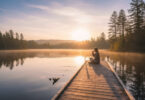
Your body runs on an ancient clock that ticks in rhythm with the sun. When you spend your days under fluorescent lights and your evenings staring at screens, that clock starts to drift. Then you wonder why you’re wide awake at midnight scrolling through your phone.
But here’s what happens after a day outside: you come home tired in that good, clean way. Your mind feels quieter. And when you finally lie down, sleep arrives without the usual bargaining and mind-racing. It’s not just the physical exhaustion, though that helps. Your body is responding to light, temperature, and stress signals that it’s been waiting millions of years to receive.
The science behind this is surprisingly specific, and understanding it might change how you think about your daily routine.
What You’ll Learn
- How natural light resets your internal sleep clock in ways artificial light can’t
- Why being outside reduces the stress hormones that keep you awake
- The temperature regulation trick that happens when you spend time outdoors
- How much time you actually need outside to see better sleep
- Simple ways to get outdoor time even with a packed schedule

Your Circadian Rhythm Craves Real Sunlight
Inside your brain, there’s a cluster of about 20,000 neurons called the suprachiasmatic nucleus. It sounds complicated, but its job is simple: tell every cell in your body what time it is. This internal clock controls when you feel alert, when you get hungry, and most importantly, when you feel sleepy.
The clock resets itself every day using light as its primary signal. But not just any light will do.
The Brightness Gap
A bright office might give you 500 lux of light. That sounds like a lot until you realize that an overcast day outside delivers 10,000 lux. A sunny day? You’re looking at 100,000 lux. Your circadian system evolved to calibrate itself using these massive amounts of natural light, and indoor lighting just doesn’t cut it.
A 2017 study in Current Biology sent people camping for a weekend with no artificial light. After just two days, their melatonin (the sleep hormone) started rising two hours earlier than it had before the trip. Their internal clocks shifted back to match the natural light-dark cycle, and they reported falling asleep faster and waking up more refreshed.
Even one hour of morning sunlight can shift your sleep schedule and make falling asleep easier that night.
The Blue Light Factor
Morning sunlight is rich in blue wavelengths, which are particularly good at suppressing melatonin and telling your brain it’s time to be awake. When you get that signal early in the day, it sets up a domino effect: strong wake signal in the morning leads to strong sleep signal 14-16 hours later.
Spending time outside in the morning gives your body that clear “this is daytime” message. Then when evening arrives and natural light fades, your brain gets the opposite signal. The contrast is what matters.
Stress Hormones Drop When You’re Outside
Cortisol is your body’s main stress hormone, and it follows a daily pattern. It should peak in the morning to help you wake up, then gradually decline throughout the day, reaching its lowest point around midnight. This drop is crucial for good sleep.
But chronic stress keeps cortisol elevated when it should be falling. You know the feeling: you’re exhausted but wired, lying in bed with your mind spinning through tomorrow’s to-do list.

The Park Effect
Japanese researchers studying “forest bathing” (spending time in wooded areas) found that just 15 minutes in a forest lowered cortisol levels by about 13% compared to being in an urban environment. The effect lasted for hours afterward.
You don’t need a pristine forest to get benefits. A 2019 study from the University of Michigan found that spending 20 minutes in any natural setting, even an urban park, significantly reduced cortisol. The key was being somewhere that felt like nature and doing something relatively low-effort like sitting or slow walking.
When cortisol drops to healthy evening levels, your body can properly ramp up melatonin production. You stop feeling that jittery, anxious energy that makes sleep impossible.
Mental Restoration
There’s also something called Attention Restoration Theory, which basically says that natural environments give your brain a break from the constant focused attention modern life demands. Your mind can wander. You notice things without trying to solve them.
This cognitive rest reduces mental fatigue, which is different from physical tiredness but just as important for sleep. When your brain isn’t exhausted from overthinking, it transitions to sleep more easily.
Nature doesn’t demand anything from you, and that lack of cognitive pressure is exactly what your overstimulated brain needs.
Temperature Regulation Gets Recalibrated
Your body temperature needs to drop by about 2-3 degrees Fahrenheit to initiate sleep. This is why you sleep better in a cool room and why a warm bath before bed actually helps (the rapid cooling afterward sends a sleep signal).
When you’re outside, especially if you’re moving, your body practices the temperature regulation dance it needs for good sleep. You warm up, you cool down, you adjust to breezes and shade and sun. This variability is something your body expects and needs.
The Indoor Temperature Problem
Climate-controlled buildings keep you at a constant 68-72 degrees all day. It’s comfortable, but it means your body’s temperature regulation system gets lazy. Then at night, when it needs to execute a precise temperature drop to trigger sleep, it’s out of practice.
Time outside, particularly in the morning or late afternoon, gives your thermoregulation system a workout. You’re exposed to cooler morning air or afternoon warmth, and your body has to respond. Research from the Netherlands suggests this temperature variability during the day helps establish a clearer nighttime cooling signal.

How Much Time Do You Actually Need?
The good news is you don’t need hours of outdoor time to see sleep benefits. Most research suggests about 30 minutes to 2 hours, depending on the intensity of light and your current sleep quality.
Here’s what seems to work for most people:
- Morning: 15-30 minutes of sunlight within two hours of waking up has the strongest effect on your circadian rhythm
- Midday: Another 20-30 minutes helps reinforce the daytime signal
- Late afternoon: Time outside before sunset can reduce evening cortisol and start your wind-down
If you can’t get all three windows, prioritize morning. A University of Colorado study found that morning light exposure had nearly double the effect on sleep quality compared to afternoon light alone.
Making It Happen
You don’t need to schedule elaborate outdoor adventures. Small adjustments work:
- Drink your morning coffee outside, even for just 10 minutes
- Take walking meetings when possible
- Eat lunch in a park instead of at your desk
- Park farther away and walk the extra distance
- Do a quick lap around the block before dinner
Consistency matters more than duration. Fifteen minutes every day beats two hours on Saturday.
The Bottom Line
Your sleep doesn’t exist in isolation from the rest of your day. It’s the endpoint of signals your body has been collecting since you woke up: how much real light you saw, how your stress levels fluctuated, how your temperature varied.
When you spend time outside, you’re not just getting fresh air or exercise (though those help too). You’re giving your ancient biological systems the information they need to run properly. You’re telling your circadian clock what time it is. You’re letting stress hormones follow their natural pattern. You’re practicing the temperature changes that facilitate sleep.
The modern world has given us incredible control over our environment, but that control has disconnected us from the natural rhythms our bodies still follow. Spending time outside isn’t about being a purist or rejecting technology. It’s about giving your biology what it needs to do its job.
So tomorrow morning, before you dive into email or turn on the TV, step outside for a few minutes. Let the light hit your eyes. Feel the temperature. Notice how you sleep that night.