
The Story Starts Below!
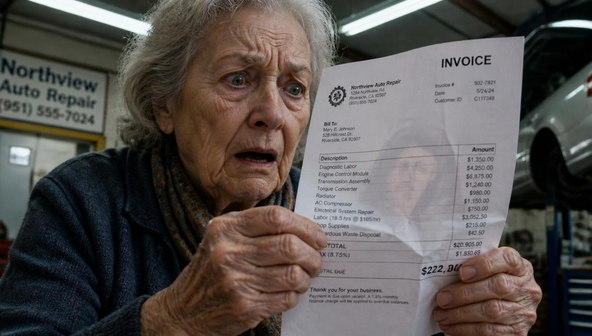
The Call Came at 2:47 in the Afternoon
I was sitting at my desk, staring at a spreadsheet, when my phone buzzed.
It was my mom’s number.
I picked up right away. She only called during the day if something was wrong.
Her voice was small. Not dramatic. Just quiet and confused, like she’d lost something and couldn’t quite name it.
She said, “Clara, I think I made a mistake.”
She Came In for One Tire
My mom’s name is Evelyn. She’s eighty-six years old.
She’s sharp. She still does her own crossword puzzles every morning.
But paperwork confuses her. Technology confuses her. And any situation that requires her to argue with a stranger makes her go very still and very quiet.
She hadn’t told me she was going to the dealership that day.
She never told me things like that. Asking for help felt like giving something up.
Four Hours in a Waiting Room
She’d driven herself to Pinnacle Auto Group for one tire.
Just one tire. A back left that had picked up a nail.
When I asked how long she’d been there, she said almost four hours.
She said the man kept coming back with new papers. She said she got confused.
She said she signed something but she wasn’t sure what it was.
The Number She Said Out Loud
I made her say it twice.
Two thousand five hundred and twelve dollars.
For a moment I couldn’t speak. I just sat there at my desk with my coat already half on.
“Stay there,” I told her. “Don’t sign anything else. I’m coming right now.”
I grabbed my bag and I walked out.
What I Found When I Got There
My mom was sitting in a plastic chair near the window.
She had a paper cup of cold coffee she wasn’t drinking.
She looked up when she saw me and her eyes got wet. Not crying exactly. Just wet.
She held out four pages of paper, folded once down the middle.
I took them from her hands and I read every single line.
Everything on That Invoice
One tire. That part made sense.
Then came a brake fluid flush. A fuel system cleaning. A cabin air filter. Something called a battery terminal treatment. Two labor charges with names I didn’t recognize.
Each one had a price next to it.
Each one added up to a number that had no business being on a bill for a woman who came in with a nail in her tire.
I looked at the bottom. $2,512.
The Man Who Sold Her All of It
The service advisor found me before I found him.
He walked over calm and easy, with a name badge and a smile that didn’t move all the way to his eyes.
He said the items on the list were all recommended for a vehicle with her mileage.
He said safety was their number one concern.
He said he would feel terrible if something happened and they hadn’t said anything.
The Manager Who Called It a Courtesy
I asked for the manager. The advisor didn’t flinch.
A few minutes later a heavier man came out. Pressed shirt. Silver watch. Very calm voice.
He said he understood my concern. He said he wanted to make this right.
Then he offered to take four hundred dollars off the bill.
He said it like he was doing us a favor. Like it was generosity and not damage control.
The Part I’m Not Proud Of
I took it.
Not because I thought it was fair. I knew it wasn’t fair.
But my mom was sitting ten feet away and she looked exhausted and small and I wanted her out of that building.
So I put the remaining amount on my own card.
I walked my mom out to her car. I told her it was handled. I told myself the same thing.
The Drive Home I Kept Thinking About
I followed her back to her house to make sure she got there okay.
We had soup. We talked about other things.
But on the drive home, I couldn’t let go of that invoice.
I knew what vague labor categories looked like. I work in billing compliance at a hospital.
I know exactly what people do when they don’t want you to ask questions about a line item.
The Evening I Couldn’t Stop
That night I sat at my kitchen table with my laptop.
I looked up Pinnacle Auto Group. I started reading reviews.
Most people sorted by stars. I didn’t do that.
I started reading the language. The actual words people used.
And after about an hour, I noticed something that made my stomach tighten.
The Pattern in the Words
A lot of the worst reviews weren’t written by the person it happened to.
They were written by someone’s daughter. Someone’s son. A neighbor.
They all started the same way. My mom went in for something small. She was alone. She was there for hours. She came out with a bill she didn’t understand.
Over and over. Different names. Same shape.
This wasn’t one bad afternoon.
What I Told Myself That Night
I closed the laptop around midnight.
I told myself I was just venting. Just confirming that this place was shady.
I told myself I’d maybe leave a review, maybe file a quick complaint somewhere, and then let it go.
I checked my watch. It was late. I had work in the morning.
I went to bed. But I left the laptop open on the table.
The Invoice I Couldn’t Stop Looking At
A few days later I photographed every page of it.
I kept the original in a folder. I made a copy. I put the photo in a new folder on my desktop.
I named the folder “Pinnacle.”
My mom’s signature was on the last page. Careful, slightly shaky cursive.
She’d signed it because a man in a clean shirt told her it was important, and she was tired, and she didn’t know she could say no.
What I Didn’t Know Yet
I thought I was finishing something.
I thought the folder was just for my own peace of mind.
I thought the worst part was already behind us, me, the bill, my mom’s quiet crying voice on the phone.
I was wrong about all of it.
The worst part wasn’t what they did to my mother that afternoon.
The worst part was how deep it went. And how long it would take me to find out.
The Folder Started Growing
I told myself I’d check one more thing.
That turned into three more things. Then ten.
By the end of the first week, the Pinnacle folder had screenshots, copied reviews, and names I’d written down in a separate notes file.
I kept finding the same story. Different people, different days, same shape.
I couldn’t close it.
I Started Sorting the Reviews Differently
Most people look at the star rating and stop there.
I didn’t care about the stars.
I read every word of every low review. I was looking for specific things.
Who was the customer? Were they alone? How long did they wait? What did they come in for?
The answers kept matching.
The Word That Kept Appearing
Elderly. That word showed up again and again.
“My elderly mother.” “My elderly neighbor.” “My elderly father-in-law.”
Always alone. Always came in for something small.
Always left with a bill they couldn’t explain.
I started a second document. Just for the cases that matched that pattern.
By day four, I had seven entries.
I Reached Out to Strangers
Some of the reviews had names attached. Real first names.
I found a few of them on the consumer forum where they’d originally posted.
I sent short messages. I said I’d had a similar experience with a family member.
I said I was trying to understand if there was a bigger pattern.
Most didn’t write back. But a few did.
Greta Wrote Back First
Her name was Greta. She was sixty-eight.
She wrote in short, direct sentences, like someone who didn’t have time to be polite about it.
Her father-in-law was ninety years old. He went to Pinnacle for an oil change.
He came home with a bill that included a transmission inspection service worth nearly seven hundred dollars.
Then Greta took the car to her own mechanic.
What the Second Mechanic Found
Her mechanic looked at the car and said the transmission hadn’t been touched.
Not recently. Not in any way that matched a fresh inspection.
Greta had the report. She’d kept it.
She sent me a photo of it that same night.
I stared at it for a long time.
This wasn’t just upselling anymore. This was something else.
Then Philip Wrote Back
Philip was fifty-two. Quiet way of writing. Very careful with his words.
His mother had paid for a coolant system service at Pinnacle.
She got a printed report that said the service was complete.
Philip took the car to another shop the following week for something unrelated.
The technician there told him the coolant system showed no signs of recent service.
That Changed Everything
Up until that point I was angry about pressure tactics.
About fear language. About a tired old woman signing something she didn’t understand.
But this was different.
If the services were billed and never done, that wasn’t just pushy sales.
That was fraud. Plain and simple.
I sat back in my chair and looked at the ceiling for a while.
My Kitchen Table at Midnight
I had cold tea next to my laptop. I hadn’t touched it.
The folder had eleven cases now. Eleven people.
Some were clear. Some were partial. Some I couldn’t fully verify.
But the shape of it was real. I could feel it the way I feel errors in a billing report at work.
Something here was built. Not accidental.
I Filed a Complaint
I found the state consumer protection office online.
I filled out their form carefully. I attached what I had.
A few days later I got an email back. It had a case number at the top.
The email said complaints like this take time to investigate. It said outcomes vary.
It felt like being handed a receipt for something that would never arrive.
Then Dolores Wrote Back
I hadn’t expected much from her message.
She said she’d been a loyal Pinnacle customer for eleven years.
She thought I was exaggerating. She said her experiences had always been fine.
But then she mentioned something almost as an aside.
The advisor she always worked with had left suddenly about eight months ago, and a whole new team had come in.
I Almost Missed That Detail
I read it twice.
Eight months ago. New team. Previous advisor gone.
I wrote it down in my notes and underlined it.
I didn’t know what it meant yet.
But in my experience, sudden staff changes at a business like this don’t usually happen for good reasons.
I flagged it and kept going.
My Mom Called on a Thursday
She called just to talk. She did that sometimes on Thursday evenings.
I tried to sound normal. I asked about her crossword. She told me about a clue she’d gotten stuck on.
She asked what I’d been up to.
I said work stuff. I kept it vague.
She didn’t push. But there was a small pause before she moved on.
She noticed. She always noticed.
The First Crack Between Us
I didn’t tell her what I was doing.
I told myself I was protecting her from stress.
But the truth was I didn’t want her to tell me to stop.
And somewhere underneath that, I knew she might.
I kept the folder open on my table that night and stared at it after we hung up.
I Thought I Was Just Getting Started
Eleven cases. A case number from the state. Two people with documentation.
I still thought I was going to hand this off to someone official and step back.
I thought I was almost done with my part.
I didn’t know yet about Meridian Drive Holdings.
I didn’t know the advisors had a name for what they were doing.
And I didn’t know that someone on the inside was about to find me.
Someone Found Me First
I hadn’t posted much online. Just a short note on a consumer forum.
I kept it factual. I said I was looking for others who’d had similar experiences at Pinnacle.
Then one morning I had a new message in my inbox.
The name wasn’t familiar. But the first line stopped me cold.
He said he used to work there.
His Name Was Wade
He asked me not to share his name publicly. He said that three times in the first message.
He was thirty-four. He’d been a technician at Pinnacle for three years.
He said he’d been let go six months ago during what the company called a restructuring.
Six months ago. That matched what Dolores told me about the old team leaving.
I wrote back the same hour.
We Messaged for Three Days First
He was careful. He backed up and restarted sentences a lot.
I could tell he was testing how much to say.
I didn’t push. I just kept responding to what he gave me.
On the third day, he told me something that changed the shape of everything I’d been building.
He said the targeting wasn’t random. It was trained.
What Ticket Value Meant
He explained a term they used internally. Ticket value.
It meant the average dollar amount on each service invoice a technician processed.
Everyone’s numbers were tracked. Every week.
The higher your ticket value, the better you were doing. The lower it was, the more pressure you felt.
There were monthly recognitions for the top performers.
The Checklist Was Built to Always Find Something
Wade said every car that came in got run through a checklist.
The checklist was designed so that something would almost always come up as a recommended service.
It didn’t matter if the car was practically new.
There was always a box that could be flagged.
He said the word “designed” very deliberately. I noticed that.
How They Chose Who to Push
He said advisors weren’t given a written policy about which customers to pressure.
It didn’t need to be written down.
They learned it by watching. By being coached. By seeing who got praised.
Customers who were older, alone, or uncomfortable with car talk were considered easier to convert.
That was the word he used. Convert.
The Paper That Meant Nothing
I asked him about the printed service completion reports.
The ones customers took home as proof the work was done.
He paused for a long time before answering.
Then he told me the reports were templated. A technician could check the boxes and print the sheet.
There was no one checking whether the work was actually finished.
I Asked Him Directly
I typed the question slowly because I wanted to be precise.
Was it possible that services were billed and never performed?
He didn’t answer right away. I watched the screen for almost four minutes.
Then he said yes. It was possible.
He said he didn’t do it himself. But he’d seen it happen.
What He Sent Me Next
Two days later, Wade sent two files.
The first was a technician evaluation rubric. It was formatted like a grid.
It listed ticket value targets, recommended service flag rates, and something called customer conversion percentages.
The second file was a slide deck from a regional management meeting.
I opened the slides and felt the air go out of the room.
What the Slides Said
The slides talked about identifying the right customers for additional service recommendations.
The language was careful. Corporate. Almost pleasant.
But the categories were clear. Customers who arrived alone. Customers unfamiliar with automotive terms.
Customers who were elderly or showed signs of uncertainty.
It was all dressed up in customer care language. But it was a targeting guide.
This Was Bigger Than One Dealership
I went back to my folder and looked at everything differently.
Pinnacle wasn’t a rogue location with one bad advisor.
It was one piece of a company called Meridian Drive Holdings. Seven locations. Three states.
The scripts, the quotas, the training. It all came from above.
This wasn’t one bad apple. This was the orchard.
I Knew I Needed a Lawyer
I’d been thinking about handing this to someone official. Now I knew who.
Not the general consumer complaint line. An attorney.
Specifically someone who handled consumer protection cases.
I spent a weekend reading through state bar listings and firm websites.
I wrote down three names. I sent emails to all three that Sunday night.
The Problem With Wade’s Files
Before I sent anything, I called a friend who knew a little about employment law.
I described the documents without naming anyone.
She asked me one question. Did he sign a severance agreement when he left?
I didn’t know. I hadn’t thought to ask.
I wrote to Wade that night. His answer came back fast. He said yes, he had signed one.
I Told My Mom I Was Fine
She called that Thursday again. Same as always.
I answered on the second ring and tried to sound light.
She asked if I was sleeping okay. She said I sounded tired.
I said I was fine. Just a busy stretch at work.
She went quiet for a second. Just a second.
Then she said okay, and we talked about her crossword again, and I hated myself a little.
The Folder Was No Longer Just a Folder
That night I sat at my kitchen table for a long time.
The tea went cold. I didn’t notice.
I had eleven documented cases, two internal corporate documents, and a source who was scared but talking.
I had a case number that was probably sitting in a filing cabinet somewhere going nowhere.
And I had an attorney’s inbox waiting for my email.
I clicked send.
The Response I Didn’t Expect
The first attorney wrote back within a day.
Her name was Ingrid. She said she’d reviewed what I sent and wanted to talk.
I read her email three times.
Nobody had used the word “substantive” about any of this before. Not the consumer protection office. Not anyone.
I sat very still for a moment.
Then I picked up my phone and called her.
She Didn’t Get My Hopes Up
Ingrid was direct from the first minute.
She said my documentation was stronger than most of what she received.
But she was honest about what that meant.
She said timelines for cases like this ran long. Months at minimum. Possibly much longer.
She said the individual damages were modest, which limited how hard anyone could push on behalf of one person alone.
The Word Class Action
She mentioned it carefully.
A class action would require more plaintiffs. More documentation. More time.
She said it was possible but not guaranteed.
I asked her what she needed from me right now.
She said she needed me to keep doing exactly what I’d been doing. And to send her everything.
Wade’s Documents Were a Problem
I told her about the files Wade sent me.
She listened without interrupting.
When I finished, she asked the same question my friend had asked.
Did he sign a severance agreement?
I told her yes.
She said that complicated things. She said the documents might not be usable without exposing Wade to a counterclaim from Meridian.
I Asked What That Meant for the Case
She said it didn’t kill anything.
It meant they had to be careful about how the documents entered the picture.
She said there were ways. But she needed to think it through.
I appreciated that she didn’t pretend it was simple.
I’d spent enough time around people who made hard things sound easy. It never helped.
Ingrid Agreed to Take It
She said she’d open a file.
She said she wanted to move my complaint up to the attorney general’s consumer fraud division, not the general intake line I’d already filed with.
I hadn’t known those were different things.
That small detail told me something. I was already in over my head in ways I hadn’t recognized.
I Told Wade That Night
He asked if this meant he was safe.
I told him I didn’t know. I said Ingrid was careful and that she understood his situation.
He went quiet.
Then he said he just didn’t want Meridian coming after him.
I said I understood.
I wasn’t sure I could promise him anything more than that.
A Letter Arrived
It came two weeks after Ingrid filed the escalated complaint.
The return address was a law firm I didn’t recognize.
It was from Meridian Drive Holdings.
I read it once standing in the kitchen. Then I sat down and read it again.
What the Letter Said
It didn’t threaten me directly.
It said my forum posts were potentially defamatory. It said Meridian took reputational harm seriously.
It questioned the accuracy of my claims.
The language was smooth and professional and designed to make me feel very small.
I noticed my hands weren’t shaking.
That surprised me.
I Called Ingrid Immediately
She asked me to photograph the letter and send it to her.
I did it while we were still on the phone.
She looked it over and said what I already suspected.
She said companies don’t pay attorneys to send letters to people who have nothing.
She said it meant we were on the right track.
I Believed Her
I also knew it didn’t make the letter disappear.
It was still sitting on my kitchen table when I went to bed that night.
I put a book on top of it so I wouldn’t see it first thing in the morning.
That didn’t work. I thought about it anyway.
My Supervisor Called Me In
It was a Tuesday.
She closed her office door and sat down across from me with that careful, neutral expression I’d learned to read.
She said she’d become aware I’d been using my work email in connection with an outside matter.
I remembered the email I’d sent. The one I hadn’t meant to send from that account.
She Wasn’t Yelling
She never yelled. That wasn’t her way.
She spoke quietly and precisely about professional boundaries. About the hospital’s liability exposure.
She said she wasn’t asking me to stop whatever I was doing outside of work.
But she said she needed it completely separate. And she needed it to stay that way.
I Said Yes
I meant it.
I was careful the rest of that day. I kept my face steady and my answers short.
But on the drive home I felt something shift inside my chest.
I hadn’t just risked my own time and energy on this. I’d now risked something at work too.
I Didn’t Tell My Mom Any of It
She called that weekend.
We talked for twenty minutes. She told me about a program she’d watched.
I told her work was fine. I said I was sleeping better.
Neither of those things was true. But I said them anyway, and she said good, and I hated the distance between us that I was building one small quiet lie at a time.
Something I Hadn’t Expected
The attorney general’s office had sent formal inquiries to multiple Pinnacle locations.
I learned this through Ingrid, not through any official notice to me.
She called on a Wednesday evening and told me calmly.
She said the investigation was moving. She said people inside the company were being contacted for interviews.
I stood in my kitchen and felt something I hadn’t felt in weeks.
Not happiness exactly. More like the ground solidifying under my feet.
Some of Them Lawyered Up
Ingrid mentioned that several service advisors had retained their own attorneys.
She said that was normal. She said it didn’t mean much either way.
But then she told me one of them hadn’t.
One of them had agreed to cooperate fully.
I asked who.
She said his name was Terrance.
I Recognized That Name
He appeared in four of the complaints I had documented.
Four different people had described the same young man. The same easy tone.
The same way he walked elderly customers through a list of services they didn’t need and couldn’t quite follow.
I had thought of him as one of the operators. One of the people running the scheme.
Ingrid said I needed to hear a few things about him before I made up my mind.
What Ingrid Told Me About Terrance
He was twenty-six years old.
He came out of a certificate program and was hired directly into Meridian’s training pipeline.
He had no prior experience in auto service before Pinnacle.
Everything he knew about the job, he learned from them.
Ingrid said the training materials Wade had given us showed exactly how Terrance was taught to work.
The fear language. The safety framing. The way to read a customer and adjust.
He Didn’t Invent Any of It
That was the part I kept turning over.
He didn’t write the scripts. He didn’t design the evaluation rubric that tied his job security to ticket value.
He learned it all from people above him who were evaluated on whether their advisors performed.
He was twenty-three years old when he started doing this.
I thought about what I knew at twenty-three. I thought about the jobs I’d taken and the things I’d done because a manager told me it was standard.
I Didn’t Feel Sorry for Him Exactly
He still sat across from my mother’s generation of people and used language designed to frighten them.
He still let confused elderly people wait in a room until they were too tired to say no.
That happened. He did that.
But he didn’t invent the room. He didn’t design the wait.
I didn’t know what to do with the space between those two things.
I just knew the space was there.
The Internal Communications Changed Everything
Ingrid called again the following week.
The discovery process had started surfacing internal emails and memos from Meridian’s regional management.
She said some of what they’d found was significant.
I asked her to tell me.
She said there were explicit directives. Written directives. Not just a culture that drifted in a bad direction.
What the Documents Said
The regional communications described a targeting approach.
Customers who arrived alone. Customers unfamiliar with automotive language.
Customers who were elderly or showed signs of what one document called decision uncertainty.
These customers were to be prioritized for full service reviews and extended consultation time.
The language was clean and professional. It could almost sound like customer care.
Except you could also read the evaluation metrics right next to it and see what the care was actually for.
The Man Who Wrote the Directive
Ingrid told me his title. Regional operations director.
She said his name was in the internal documents but would likely not appear in any public filing.
I asked why.
She said it was part of the company’s cooperation agreement. They would cooperate fully in exchange for limiting individual identification.
She said that was the price of getting the settlement at all.
I Told Her I Didn’t Like That
She said she knew.
She said she didn’t like it either.
But she said the alternative was a longer fight with a less certain outcome for the 340 people in the restitution pool.
I sat with that number for a moment.
340 people. Most of them older. Most of them had already paid and never expected to see any of it back.
I told her fine. I told her to keep going.
There Was Also the Former Advisor
Ingrid had found him.
The one Dolores mentioned. The service advisor who left Pinnacle eight months before I ever set foot in that dealership.
He was working at an independent shop across town now.
Ingrid said he had agreed to speak with her.
She said he had filed an internal complaint before he left, and that the complaint had been closed without any action taken.
What He Told Ingrid
He said he had refused to use the targeting approach with certain customers.
He said his manager had made clear that his numbers were suffering and that it reflected poorly on the team.
He said there came a point where he understood he was being managed out.
He filed the complaint as a last attempt to flag what was happening internally.
It went nowhere.
He packed his things and left.
I kept thinking about the people who came in during the eight months between when he left and when my mother walked through that door.
The Physical Cost of All of It
I wasn’t sleeping well. I knew that.
But I didn’t understand how visible it had become until a colleague I’d worked beside for six years stopped me in the hallway.
She asked if I was okay. She said it plainly, without making it a thing.
I said I was fine.
She looked at me for a moment and then nodded slowly in the way people do when they know the answer is no but don’t want to press.
My Supervisor Called Me In Again
Same closed door. Same careful neutral face.
She said she wasn’t here to repeat herself. She said she trusted I’d kept things separate as agreed.
But she said there had been conversations at a level above her. About my focus. About my judgment.
She said the promotion consideration that had been in motion since spring had been paused.
She didn’t say why directly. She didn’t have to.
I Drove Home Very Quietly That Night
No radio. No podcast.
Just the sound of the road and the dark coming in early the way it does in November.
I thought about what I’d spent. My time. My friendships. My standing at work.
I thought about my mother, who didn’t know any of this, who was at home right now probably arguing pleasantly with a television program.
I thought about the 340 people who were going to get some of their money back.
I tried to hold all of those things at once.
I couldn’t decide yet if they balanced.
The Investigation Concluded
Ingrid called me on a Tuesday morning.
She said the attorney general’s office had finished its review.
She said the findings were significant. She said that word carefully, like she was measuring it.
I sat down at my kitchen table. My coffee went cold while she talked.
She said Meridian Drive Holdings had been found to have run a systematic deceptive trade practice across five of its seven locations.
What They Found
The internal targeting directives were in the findings.
The templated completion reports were in there too.
Wade’s documents. Terrance’s testimony. The former advisor who had walked away.
All of it had held together.
Ingrid said the evidence package was strong. She said the attorney general’s office didn’t often get documentation this clean.
I thought about my kitchen table at midnight. The cold tea. The growing folder.
The Settlement Numbers
Meridian agreed to a consent decree.
That meant required reforms. New consent forms. Audit procedures. Staff retraining.
They also agreed to pay 1.4 million dollars in civil penalties to the state.
And they agreed to a consumer restitution fund.
Ingrid said approximately 340 verified victims would receive partial reimbursements.
She said the average would be around 60 percent of their disputed charges.
I Asked What Sixty Percent Meant
Ingrid said it meant they wouldn’t get everything back.
She said it was still real money for people who had expected nothing.
I thought about Greta’s father-in-law. About Philip’s mother.
About all the people who had written to me after the forum post. Thirty-one of them.
I thought about how many more there were that I never found. People who didn’t know to look.
The Part That Still Stings
The regional operations director retired.
He wrote the targeting directive. He built the system that put my mother in that waiting room for four hours.
He wasn’t named in any public filing.
Ingrid explained again that it was the price of getting the company’s full cooperation.
I understood it. I still didn’t like it. I don’t think I ever will.
What Happened to Terrance
He cooperated fully.
He received no formal penalty beyond being a named witness in a deceptive practices investigation.
Ingrid said that was fair given his circumstances.
I thought about that word. Fair.
He was twenty-three years old when he started. He didn’t write any of it.
But my mother sat across from him and he used the fear language anyway.
I still didn’t know how to square that.
What Happened to Wade
Meridian never came after him for the documents.
Ingrid said she wasn’t surprised. Drawing attention to those documents in a lawsuit would have hurt them more than Wade.
He was working again. Different city. Back-end parts coordination. No customer contact.
He asked me not to include his name in anything I wrote publicly.
I told him I wouldn’t. I kept that promise.
The Restitution Check
Mom called me on a Thursday.
She said a check had arrived in the mail. She said she wasn’t sure what it was at first.
I told her what it was.
She was quiet for a moment. Then she said she was going to donate it to the senior center on Maple Street.
She didn’t ask what I thought. She just told me.
That Was the Right Move
I knew it immediately when she said it.
She was taking the money and turning it into something she chose.
Not something the system gave back. Not something I won.
Something she decided.
I told her that sounded like a good idea. She said she thought so too.
We didn’t talk about the case after that.
I Wrote It All Down
I went back to the consumer forum where this started.
I wrote a long account of everything. The invoice. The pattern. The investigation. The outcome.
I didn’t write it like a victory. Because it wasn’t exactly that.
I wrote it as plainly as I could. What happened, what was found, what the system did and didn’t do.
Two regional news outlets picked it up.
The Messages I Got Back
Thirty-one new messages came in the first week.
Some were from people saying thank you. Some had their own stories.
A few were from strangers defending the dealership. Those stung briefly and then faded.
But one message stopped me completely.
A woman wrote that her eighty-two-year-old mother had gone to a different Meridian location.
She said she’d had no idea any of this was happening until she read what I wrote.
What I Understood in That Moment
The case was finished. But the need for it wasn’t.
There were more Meridian locations. There were other companies built the same way.
There were more people like my mother who drove themselves somewhere alone.
I couldn’t fix all of that.
I had to keep reminding myself I couldn’t fix all of that.
My Promotion Was Gone
My supervisor confirmed it in a brief meeting.
She said the consideration had been removed for this cycle.
She said the word judgment twice. Not loudly. Just precisely.
I nodded. I said I understood.
I drove home the same way I’d driven home for months. Quiet. Just the road.
The difference now was that the case was over.
The cost of it was still sitting right there.
Ingrid Called One More Time
She said the civil class action was still moving forward.
She said it would likely settle in another year or more. She said other attorneys were handling it from here.
She said Clara, you built this.
I told her I knew.
But I also knew what I’d built it with. My time. My friendships. My mother’s privacy.
I wasn’t sure I’d accounted for all of it yet.
I Drove to Mom’s House That Saturday
She had the television on when I arrived. Some cooking program she half-watched.
She looked up when I came in. She didn’t say anything about the case.
She just asked if I wanted coffee.
I said yes. I sat down at the kitchen table.
She moved around her small kitchen easily, the way she always had.
I watched her and I felt the weight of the last fourteen months slowly begin to settle.
She Poured the Coffee Without Asking
She didn’t ask how I took it. She already knew.
She’d known for fifty-four years.
I watched her hands on the coffee pot. Steady enough. A little slower than they used to be.
She set the mug in front of me and sat down across the table. The cooking show murmured in the other room.
Neither of us said anything right away. That was okay.
The Silence Felt Different Now
Before, the silence between us had been careful. Full of things we were not saying.
This one felt quieter than that.
She wrapped both hands around her own mug. She looked out the window at her small backyard.
I thought about all the phone calls over the last fourteen months. How many of them had been about the case.
How few of them had just been about her.
She Brought It Up First
She said she’d read the news article.
The one the regional outlet ran. She said her neighbor had found it and shown her.
I didn’t know what to say to that. I asked if she was okay with it.
She thought for a second.
She said she wasn’t sure okay was the right word.
I Asked Her What the Right Word Was
She looked at me. She took a small sip of coffee.
She said it felt strange to see her afternoon at the dealership turn into something that big.
She said she knew that wasn’t what I meant for it to be. But that it still felt strange.
I told her I understood. I told her I was sorry it felt that way.
She nodded. She didn’t say it was fine, because it wasn’t entirely.
I Had to Say the Real Thing
I’d been practicing the words on the drive over.
I still got them slightly wrong when I said them out loud.
I told her that I thought I’d handled the whole thing the way I needed to handle it. Not the way she needed me to.
She looked at me carefully when I said that.
I kept going. I said I hadn’t asked her enough. I said I’d just decided.
She Didn’t Let Me Off Easy
She was quiet for a moment after I finished.
Then she said something I hadn’t expected.
She said she knew I loved her. She said she’d never doubted that part.
But she said when I walked into that dealership and took over, something shifted.
She said she’d gone from being a person who’d had a bad afternoon to being someone who needed rescuing.
That Word Landed Hard
Rescuing.
I turned it over in my head while she talked.
She said she understood why I did it. She said she probably needed some of it.
But she said there’s a difference between helping someone and taking the whole thing out of their hands.
She said I hadn’t always known where that line was.
I didn’t argue. Because she was right.
I Asked What She Wished I’d Done
She thought about it for a while. Long enough that I didn’t rush her.
She said she wished I’d asked more questions before I acted.
She said she wished I’d told her what I was doing before I was already doing it.
She said she wished, just once, that I’d let her decide whether she wanted to be part of the fight.
I felt that one in my chest.
The Hardest Part to Hear
She said she felt proud of what came out of it.
The 340 people. The restitution. The consent decree.
But she said sometimes she felt like the whole thing had happened to her twice.
First at the dealership.
Then again, while I was fighting it.
I didn’t say anything for a while after that. There wasn’t anything fast or easy to say.
I Told Her the True Thing
I told her I’d been scared.
Not just about the invoice. Not just about the dealership.
I told her that underneath all of it, I’d been scared about her getting older.
About not being able to protect her from things.
She looked at me with those pale blue-gray eyes and she didn’t seem surprised.
She said she knew. She said she’d known that for a while.
She Reached Across the Table
She put her hand over mine.
Her hand was cool and light and thin in that way that older hands get.
She said Clara, I’m still here.
She said that simply. No drama in it.
I had to look down at my coffee for a second. I didn’t want to cry at her table again.
She squeezed my hand once and then let go.
What She Said After That
She said she wasn’t angry.
She wanted me to know that clearly.
She said she was glad someone had finally looked at what that place was doing. She meant that.
But she said she needed me to hear that her life wasn’t just material for a case.
She said she was still a whole person. Still her.
I told her I knew that. I told her I needed to do better at acting like it.
The Cooking Show Was Still On
We sat there a while longer without talking much.
The cooking show someone was making a soup I’d never heard of.
Mom commented on the technique. She said the woman was using too much heat.
I smiled. She watched the screen with mild authority.
And just like that we were back to being two people sitting at a table.
That Was the Moment I Understood
The thing I’d really been fighting for was this.
Not the consent decree. Not the civil penalty.
This table. Her voice. The way she said too much heat like it mattered.
I’d spent fourteen months running toward something that was already right here.
I hadn’t lost it. But I’d come close. And that was worth knowing.
We Sat Until the Light Changed
The afternoon light moved across the kitchen floor.
She refilled my coffee without asking. I let her.
I didn’t check my watch. I didn’t think about the folder or the case or what still needed doing somewhere in the world.
I just sat there.
She was eighty-six years old and still sharp and still proud and still here.
That was the only thing that needed my full attention now.


