
The Story Starts Below!
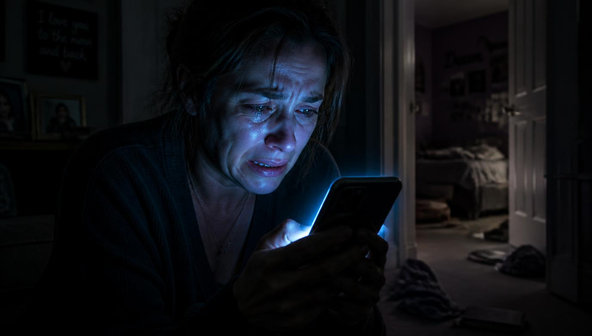
The Sound That Woke Me
I was already awake before I heard anything. That happens sometimes. My body knows when something is wrong before my brain catches up.
It was 4:28 in the morning. The clock on my nightstand said so in red numbers.
Then I heard it. A soft thud from the bathroom down the hall. Then water running. I got up.
What I Found on the Floor
The bathroom light was on. The door wasn’t fully shut. I pushed it open and stopped.
Sarah was on the tile floor. She was sitting with her back against the tub. Her left leg was a mess from the knee all the way down. The skin was torn and raw and dark with dried blood.
Her shirt was ripped along the shoulder seam. Her face was pale and sick-looking. She smelled like alcohol and cold air.
She Told Me to Go Back to Bed
“Mom.” That was the first thing she said. Just my name. Then, “I’m fine. Go back to bed.”
She wasn’t fine. She could barely hold her head up.
I got down on the floor next to her. I didn’t yell. I didn’t ask questions yet. I just put my hand on her face and looked at her eyes to make sure she was still with me. She was. Barely, but she was.
Getting Her Up
It took a few minutes to get her on her feet. She kept saying sorry. She said it over and over in a small flat voice.
I got her out of her clothes and into the shower. She stood there with her forehead against the tile and let the water run over her.
I sat on the edge of the tub and waited. The scrape on her leg looked worse under the light. Long and deep in places. She was going to feel it tomorrow.
Into Bed
I helped her dry off and get into a clean shirt. I walked her to her room. She sat on the edge of the bed like the effort of crossing the hall had used up everything she had left.
I pulled the covers up around her. She was asleep in maybe two minutes.
I stood there in the dark for a moment. I could hear her breathing. It was steady. She was okay. But she was not okay.
The Phone on the Floor
I went back to the bathroom to clean up. Her jeans were in a pile on the floor. Her phone had slid out of the pocket.
The case was black rubber with a crack across the corner. There was a little sunflower sticker on the back, half-peeled off. She’d put it there when she was seventeen and never took it down.
I picked it up. I told myself I was looking for an emergency contact. I told myself I just needed to understand what kind of night it had been.
2:41 AM
The photo gallery was the third thing I opened. I wasn’t looking for photos. But they were right there.
Three pictures. All taken at 2:41 in the morning. The first one made me sit down on the bathroom floor.
It was taken from the passenger seat of a car. The angle caught the driver clearly. He was a young man with sandy blond hair. He was holding his phone in his right hand. I knew who he was.
Trent Ashford
His name was Trent Ashford. He was twenty-two. His family owned The Fieldhouse, the restaurant where Sarah worked.
They also owned a hardware supply company. A commercial laundry. A share in the only car dealership in the county.
I looked at the second photo. Same angle. Same man. Same phone in his hand. The third photo was looking out through the windshield. The road ahead was not straight. The trees along the shoulder were blurring past at the edge of the frame.
Sitting in the Hallway
I moved out to the hallway. I sat down with my back against the wall outside Sarah’s room. I could hear her breathing through the door.
I looked at those three photos four more times. The timestamp didn’t change. 2:41 AM, every one of them.
I didn’t know yet what had happened to the car. I didn’t know yet that the story was already being written without me. I just sat there in the dark with my daughter’s phone in my hands and felt something cold settle in my chest.
A Careful Life
I want you to understand something about where I stood before that night. I had built a careful life. Not a big one. But mine.
I work as an office manager for an insurance firm. I own a small house on the east side of Deller County. The siding is faded sage green. I’ve kept it up by myself for eight years.
Sarah’s father left when she was eleven. Since then it’s been the two of us. I know what we have and I know what we don’t, and I’ve always known the difference matters in a town like this.
What Sarah and I Are
Sarah and I argue. We’ve argued more in the last year than ever before. She keeps putting off her community college enrollment. She lets other people decide the pace of her life and it drives me out of my mind.
But underneath all of that, we are solid. We both know it. The arguments are just noise on top of something that doesn’t move.
That morning I sat in the hallway and I watched the light change outside the window at the end of the hall. I watched it go from black to grey to pale and thin. I held her phone and I thought about what those photos meant.
My Neighbor’s Words
I didn’t sleep. Around seven-thirty I went outside to get the recycling bin from the curb. My neighbor Frank was out walking his dog.
He stopped. He said he’d heard there was a car found against a drainage culvert on Route 9 last night. He said it like news. Like neighborhood talk.
He said the car belonged to one of the Ashford boys. I nodded. I said I hadn’t heard. I went back inside and stood in my kitchen and stared at the wall.
Before Noon
By noon I knew Sarah’s name was already in people’s mouths. I know how this county works. I’ve lived here long enough.
I heard it from two different directions before lunch. The version going around was simple and specific. Sarah Calloway had borrowed a car. Sarah had driven drunk on Route 9. Sarah had hit the culvert and walked away.
Trent Ashford’s name was there too, but only as the registered owner. The story had him lending her the car earlier in the evening. Multiple people claimed to have heard him say so himself.
She Woke Up Around Two
Sarah came out of her room around two in the afternoon. She moved slowly. The scrape on her leg was stiff and she walked with a slight hitch.
She sat at the kitchen table and I put a glass of water in front of her. She looked at it.
Then she looked at me. And I could see in her face that she already knew. She already knew what was being said. She’d seen the texts. Someone had told her. She wasn’t surprised. She just looked worn all the way through, like someone who has been waiting for exactly this.
The Photos Are Enough
I told her I’d seen the pictures on her phone. I told her I was sorry I’d looked without asking. She shook her head like that part didn’t matter.
I put the phone on the table between us. I told her those photos showed exactly who was driving that car.
I believed it then. I really believed it. I thought a clear photograph with a timestamp was the kind of fact that fixes things. I thought the truth just needed to be placed in the right hands. I didn’t know yet how wrong I was.
She Didn’t Want Me to Fight
Sarah drank the water slowly. She set the glass down.
Then she said it. “Don’t do anything, Mom.” Her voice was quiet. Not angry. Just tired in a way that went deep.
I looked at her. I asked her what she meant. She said she meant all of it. Don’t call anyone. Don’t show anyone the photos. Don’t make it bigger than it already was.
I didn’t say yes. I didn’t say no. I just watched her get up and go back to her room.
What the Word Sorry Does
She said sorry three more times that day. Once when she knocked over the water glass. Once when I brought her ibuprofen. Once when I sat on the edge of her bed that evening and she saw my face.
None of those things were her fault. Not the glass. Not the leg. Not any of it.
But Sarah apologizes the way some people breathe. Automatically. Without thinking about it. I’ve watched her do it her whole life and I’ve never been able to stop it.
Friday Morning
I let her sleep in on Friday. I went to work. I sat at my desk and answered emails and transferred calls and acted like I was a normal person having a normal day.
I was not a normal person having a normal day. I had my daughter’s phone photos saved to my own phone. I had three clear images of Trent Ashford behind the wheel.
I kept looking at them between calls. Each time felt the same. Clear. Obvious. Enough.
Pam Ashford Called
I was at my desk around two in the afternoon when my cell phone rang. I didn’t recognize the number at first.
It was Pam Ashford. Her voice was warm and smooth. She said she’d heard Sarah was going through a hard time. She said she hoped Sarah was getting the support she needed.
She didn’t say anything wrong. Not exactly. But by the time she hung up I felt like Sarah had just been moved from one category to another. Not a girl something happened to. A girl with problems.
The Category Shift
I sat with my phone in my hand after Pam hung up. I thought about the words she’d used. Struggling. Difficult time. Help she needs.
None of those words were lies. But they weren’t about what actually happened either. They were about a different version of Sarah. A Sarah who was the problem.
That’s what the call was. It wasn’t sympathy. It was a reclassification. And it had been delivered so gently that I almost didn’t catch it.
Brianna’s Text
Sarah showed me the text from Brianna that afternoon. She held her phone out and didn’t say anything. Just let me read it.
Brianna had texted that she thought it was better if Sarah took some time away from work. That things were complicated right now. That she hoped Sarah understood.
Sarah took the phone back. She stared at the screen. Then she set it face-down on the table. She didn’t say a word about it and that was somehow worse than if she had cried.
Curtis and the Hours
Sarah checked her schedule online Friday evening. She’d been dropped to zero hours. No message from Curtis explaining why. No call. Just a blank week where her shifts used to be.
She showed me the screen. I looked at it.
She said his name once. Curtis. Just that. Then she closed the laptop and went to the kitchen and poured herself a glass of water and stood at the sink with her back to me.
I Went to the Sheriff
Saturday morning I put on my navy coat. I drove to the county sheriff’s department with the photos on my phone.
The deputy at the desk was polite. He listened. He wrote things down on a notepad. He said someone would follow up with me.
I asked when. He said he couldn’t say exactly. He said these things took time to look into. He said it in the patient voice of someone who has said that sentence many times before.
The Incident Report
I went to the county recorder’s office next. I asked for the incident report from Route 9 on Thursday morning.
The woman gave me a form to fill out. I filled it out. I waited. She came back with two pages.
I stood at the counter and read them. The cause of the accident was listed as undetermined. The driver was listed as unknown. Trent Ashford was listed as registered owner. There was a note that he was not present at the scene. That was all.
What the Paper Said About Sarah
His name was there and it was clean. Unknown driver. Not present.
Sarah’s name wasn’t in the report at all. But her name was everywhere in the county. In the mouths of people at the gas station and the diner. In the story that had been spreading since Thursday morning.
The paper said nothing. The people said everything. And what the people said was already starting to calcify into something that felt like fact.
No Follow Up Came
I waited through the weekend. No call from the sheriff’s department. Nothing on Monday. Nothing Tuesday.
I called Wednesday morning and asked for an update. The woman on the phone said my concern had been noted. She said the matter was still being looked into. She said someone would contact me if there were any developments.
I hung up. I sat at my kitchen table. I thought about the word noted.
Sarah Said the Word Please
Wednesday evening Sarah came and sat across from me. She folded her hands on the table.
She said she knew I’d gone to the sheriff’s office. She said she’d heard it from someone who saw my car in the lot. Then she said it again. Don’t do anything. And this time she added one word.
Please.
She said please in a way that wasn’t asking. It was closer to warning. Like she already knew what was coming back around and she didn’t want to be standing in the path of it when it did.
What She Knew That I Didn’t
She sat there and told me quietly that every time I walked into an office or made a call, something new was added to the story about her.
She didn’t have proof of that. Not yet. But she felt it. The texts that had gone cold. The friends who weren’t answering. The way Brianna’s message was worded like Sarah was already something fragile and unreliable.
She said being right wasn’t the same as winning. She said it like she’d thought about it for a long time. And I didn’t have an answer for her. Not yet.
I Still Believed in the Photos
I still believed in those three pictures. I couldn’t stop. They were so clear. So specific. The timestamp, the face, the phone in his hand.
I thought if I just found the right person to show them to. The right official. The right authority. Someone would have to act.
That was still what I believed on that Wednesday night. I put Sarah to bed. I went to my own room. I lay there in the dark and I thought about who I hadn’t tried yet.
The Machine I Didn’t Know Existed
I didn’t have a name for what was happening yet. I didn’t understand that there was a shape to it. That it had a design.
I just knew that every door I’d knocked on had opened just wide enough for someone to look polite and then close again. And that each time one closed, something else happened to Sarah.
I lay there thinking. And somewhere under the exhaustion, a different kind of question started forming. Not who had the authority to act on the truth. But who had decided they wouldn’t.
Deborah
I went to Deborah on Thursday. She sits three desks down from me at the firm. She’s worked in Deller County her whole life.
I didn’t tell her everything. I told her enough. I said the photos were clear and nobody was moving on them.
She took her reading glasses off. She set them down on her desk. She said she needed me to understand something about how things worked in this county.
The Web She Described
Deborah spoke quietly. She named Douglas Ashford’s connections one by one. The business association. The county commissioners. The sheriff.
She said none of it was corruption exactly. She said it was more like a fabric. Everyone woven into everyone else.
She said Randall Pruett had been at the Ashford family barbecue eight years running. I thought about the deputy who’d taken my notes. His patient voice. The word noted. I understood it differently now.
What She Said About the Paper
I asked about Gil Pacheco. He writes for the county paper. I’d met him twice at community events.
Deborah said he was a decent reporter. She said his editor had lunch with Douglas Ashford twice a year.
I sat with that. I asked her if she thought Gil would even look at the photos. She said he might look. She said looking and printing were two very different things in this county.
Howard Kessler
I called Howard Kessler that afternoon. He’s the lawyer I used for my divorce eight years ago. He practices general law downtown.
He told me to come in Friday morning. I wore my navy coat. I sat across from his desk and showed him the three photos on my phone.
He looked at them carefully. He held his glasses in his hand the whole time. Then he set them back on and looked at me and started talking about money and time.
What Howard Told Me Straight
He said civil action was possible. He said it would be slow and expensive. He said Sarah would need to be an active witness.
He said the Ashfords’ attorney was a man named Parrish. Thirty years in this county. Never lost in front of a local judge.
He didn’t tell me not to try. But he laid out the cost the way you lay out a bill. He wanted me to see the full number before I agreed to anything.
The Story Had Grown
I came home from Howard’s office to find Sarah on the couch. She had her phone in her lap. Her face was flat and closed.
She told me there was a new version going around. This one said she had a history of problems at The Fieldhouse. That she’d caused trouble before. That this wasn’t the first time.
None of it was true. But it was specific. Specific things sound real even when they aren’t. I sat down next to her and I didn’t say anything for a moment.
Where It Came From
I asked Sarah who was saying it. She shrugged. She said it didn’t matter who started it. It was already everywhere.
She was right about that. A story doesn’t need one mouth once it gets moving. It just travels.
What I noticed was how detailed it was. It wasn’t just that Sarah drank too much. It was a specific scene at work. A specific problem. That level of detail doesn’t come from nowhere. Someone built it.
A Former Classmate Told Her
That afternoon a girl Sarah had gone to school with called her. She said she wanted Sarah to hear it from a friend before anyone else said it.
She ran through the whole new story. She listed the details with the careful tone of someone who believes they’re helping.
Sarah listened without interrupting. She thanked her. She hung up. Then she came and stood in the kitchen doorway and told me she wanted to leave Deller County. She said it calmly. That was the worst part.
What Sarah Said
She told me nothing I did would give back what she’d already lost. Not the job. Not the friends. Not the way people looked at her now.
She said every time I pushed, something came back at her. She said she was the one living in the middle of it.
She said being right wasn’t the same as winning. She’d said it before. But this time I heard something else underneath it. She wasn’t asking me to stop because she was afraid. She was asking me because she was exhausted and she was watching me make it worse.
The Thing I Finally Understood
I stood in the kitchen after she went back to her room. I thought about what she’d said.
Every official visit I’d made, something new had been added to the story about her. The front door approach wasn’t working. It was feeding the machine instead of stopping it.
The photos were real. The truth was real. But I’d been walking into offices and handing the truth to the exact people who had already decided what to do with it. I had to stop doing that.
I Appeared to Stop
I called Howard’s office Monday morning. I told him to hold. I didn’t call Gil Pacheco back. I didn’t drive past the sheriff’s department.
I went to work. I went to the grocery store. I filled my car up at the gas station on Route 4. I was quiet and I looked tired, which was easy because I was genuinely tired.
I let people see me looking worn down. I let them draw their own conclusions. I needed the Ashfords to think the problem had solved itself.
What Deborah Said in Passing
I kept going back to one thing Deborah had said. She’d said it quickly and then moved on, the way you do when you’ve said more than you meant to.
She’d said this wasn’t the first time a story like this had touched the Ashford family. Two other young women. Two other quiet exits from the county.
I called her back. I asked her to tell me everything she remembered. She was quiet for a moment. Then she started talking.
A Pattern With a Shape
Deborah didn’t know details. She knew the shape. A young woman. An Ashford connection. A damaging story that arrived fast and stuck. A quiet departure within the year.
She said it twice in four years the first time and nine years before that.
Then she used one word that I couldn’t stop thinking about. She said the whole thing felt practiced. Not as an accusation. More like an observation from someone who had watched the county long enough to recognize a thing it knew how to do.
Practiced
That word sat in me like something cold.
Practiced meant someone had done it before and it had worked. Practiced meant there was a method. A method meant someone who knew the steps.
Douglas Ashford was a businessman. Pam was social. Trent was reckless. None of them had the careful skill it took to manage a story this cleanly. Which meant someone else did. Someone who stayed in the background. Someone who had done this at least twice before and had never had a reason to be careful.
I Started Looking for That Person
I didn’t know her name yet. I didn’t know anything except the shape of a gap where someone should be.
But I knew how to look at records. I knew how to read absence. I knew that when a story disappears in a county this size, something or someone made it disappear.
I started pulling old records. Property transfers. Archive gaps in the county paper. The places where a story should have lived but didn’t. I was looking for the person who cleaned up after the Ashfords. And I was going to find them quietly, because quiet was the only thing left that they wouldn’t know how to stop.
The Name in the Records
I started with the county paper’s online archive. I went back ten years.
I wasn’t looking for articles about the Ashfords. I was looking for the holes. The stories that almost happened and then didn’t.
Nine years ago there was a small item about a young woman named Lacey Durn who had worked at the hardware supply. Two sentences. Then nothing. No follow-up. No explanation. Just silence after that.
Four Years Back
Four years ago there was a name in the letters section. A woman named Donna Petit wrote a short letter about fairness in the workplace.
The letter ran once. Nobody responded in print. Donna Petit’s name never appeared in the paper again.
I wrote both names down. Lacey Durn. Donna Petit. Then I went to the property transfer records to see when they’d left the county.
Both of Them Gone
Lacey Durn had transferred her rental lease within eight months of that small item in the paper. Donna Petit’s car registration lapsed about a year after her letter ran.
Both of them just gone. Clean and quiet.
No drama. No public dispute. No forwarding address in any record I could find. That was the pattern Deborah had described. And now it had two real names attached to it.
Looking for the Cleaner
The Ashfords hadn’t done this themselves. I was sure of that now.
Douglas was a public man. Pam made phone calls and smiled. Trent was careless. None of them had the patience to erase someone this quietly.
Someone else did the careful work. Someone who understood records and appearances and exactly how much pressure to apply without leaving marks. I needed to find that person.
The Foundation’s Name
I started cross-referencing. I looked for anyone whose name showed up near both gaps.
County board memberships. Committee rosters. Nonprofit boards. I was looking for someone who sat close enough to power to know things and far enough away to stay invisible.
Then I found it. The Deller County Business and Community Foundation. Substantially funded by Ashford donations. And its director had been in her position for twelve years.
Celia Marsh
Her name was Celia Marsh. I read her bio on the foundation’s website three times.
Twelve years as executive director. Previously on the county economic development board. Before that, the county crisis response committee. She had been somewhere near every structure that managed public perception in this county for over a decade.
Her photo showed a trim woman with a dark bob going silver. She looked calm. She looked like someone who was very good at listening without giving anything away.
What She Looked Like on Paper
There was nothing wrong with her record. That was the point.
Every organization she’d touched looked better after she left it. Every initiative she’d supported had come off clean. She had a small office on County Road 7 and a modest salary and a reputation for being effective and quiet.
Quiet. That word again. I was starting to understand that quiet wasn’t always what it looked like. Sometimes quiet was a skill someone had sharpened on purpose.
The Decision I Made
I sat at my kitchen table with my notes spread out. I thought about what I could do with Celia Marsh’s name.
I couldn’t walk up to her and accuse her of anything. I had a pattern. I had two names and two gaps in the public record. That wasn’t enough.
What I needed was for her to think the situation was closing. I needed her to relax. Because practiced people make mistakes when they think the job is done.
Letting the Word Travel
I called a woman named Greta who is in my Tuesday morning coffee rotation. Greta knows everyone.
I told her I was exhausted. I said I wasn’t sure the photos were as clear as I’d thought. I said Sarah and I might need to consider moving on.
I said it quietly and with just enough waver in my voice that Greta would feel like she’d heard something private. I knew exactly where that information would go.
Sarah Heard Me
Sarah came out of her room an hour after I got off the phone with Greta. She’d heard part of the call.
She stood in the kitchen doorway and looked at me. She asked if I meant it.
I looked at her straight. I told her no. I told her I was trying something different. She was quiet for a moment. Then she nodded once and went back to her room. She didn’t ask questions. She trusted me and that weight landed on me hard.
Three Days Later
Three days later Greta called me back. She said she’d run into someone who’d asked about me.
She said the woman had seemed relieved to hear I was stepping back. She said the woman had mentioned that it was for the best. That some things were better left to settle.
Greta said she didn’t know who the woman was exactly. But she described the dark bob and the neat blazer. I knew. It was Celia Marsh. And she was already moving.
She Spoke to Curtis
The next piece came from an unexpected place. A woman named Paula who waitressed at The Fieldhouse texted Sarah out of the blue.
She said Curtis had been on the phone that afternoon. She’d heard him say that it was important Sarah’s departure looked voluntary. That the framing mattered.
Paula said she didn’t know why she was telling us. She just thought we should know. I read that text four times. Curtis hadn’t decided that framing on his own. Someone had told him what to say.
The Shape of It Now
I wrote it all out on a piece of paper that night. The two previous women. The gaps. The foundation. The funding. Celia Marsh at the center of it.
She was the one who talked to Curtis. She was the one who shaped the story. She was the one who had done it before and expected it to work the same way again.
She thought I was backing down. She was starting to wrap up loose ends. And that meant she was going to talk more than she should.
I Just Had to Wait
I went to work. I came home. I made dinner. I looked tired because I was tired.
But underneath the tired I was very still and very focused. I was watching the shape of what Celia Marsh was doing now that she thought the threat had passed.
People who think a problem is solved stop being careful. I’d seen it in small ways all my life. I just needed to wait for the moment she stopped being careful in front of someone who would tell me. I didn’t have to wait very long.
What Marta Told Me
Marta Osei called me on a Tuesday evening. She’s seventy-one and she’s known me for fifteen years.
She said she’d been at a small county foundation event the night before. She said Celia Marsh had been there. She said Celia had been talking to two other women about the Route 9 accident.
Marta’s voice was careful when she got to the next part. She said Celia had mentioned the damage to the car. Specifically. The dent on the passenger door. The exact location of it. And Marta said she was almost certain that detail had never been in any public report.
What That Detail Meant
I stood in my kitchen after I hung up with Marta. I didn’t move for a long moment.
The dent on the passenger door. The exact location. Celia Marsh knew it.
That detail was never in the public report. I had seen the report. I had read every word of it. The passenger door was not mentioned anywhere. The only way Celia knew that was if someone inside the sheriff’s department had shown her the full file. And that changed everything.
I Called Marta Back
I called her back within ten minutes. I asked her to tell me exactly what Celia had said. Every word she could remember.
Marta repeated it slowly. She’s careful like that. She said Celia had described the damage in a way that sounded like she was explaining it. Like she was telling the other women what the car looked like when the deputies found it.
Marta said it felt odd at the time. She hadn’t been sure why. Then she’d gone home and thought about it and called me.
What Marta Didn’t Know She Had
Marta didn’t realize what she was holding. She thought she was giving me something interesting.
She was actually giving me the thread I’d been looking for. Celia Marsh knew a restricted detail. That meant a connection inside the sheriff’s department. That meant the whole web had a visible stitch in it now.
I thanked Marta. I told her it was helpful. I kept my voice steady. I didn’t want her to know yet how important it was.
Writing It All Down
I sat at the table after the call and wrote everything out again. This time in order.
Celia Marsh. Twelve years. Two previous women who left the county. The gaps in the record. The call to Curtis about framing. The foundation money from the Ashfords. And now the passenger door detail she should not have known.
It was a line. A clear one. Connecting her to the suppressed evidence and the people who had protected the Ashfords before. I had the line now. I just needed the right moment.
Howard Kessler Again
I called Howard the next morning. I told him I needed to come in.
He listened while I laid it out. The pattern. The two previous women. Celia Marsh. The detail about the dent. He held his glasses the whole time and didn’t interrupt.
When I finished he set his glasses back on his face. He said it was significant. He said the passenger door detail was the kind of thing that opened a different kind of question. Not just about the accident. About the report itself and who had access to it.
What Howard Said About Parrish
Howard said he needed to think carefully about the next step. He said if we moved too fast, Parrish would find a way to bury it.
Parrish had thirty years in this county. He knew every judge. He knew every procedure. He knew how long to drag something until people got tired.
Howard said the detail about the dent had to land somewhere it couldn’t be quietly absorbed. He said we needed it in public view before the Ashfords knew it was coming. He said timing was everything.
Gil Pacheco
I called Gil that same afternoon. He answered on the second ring.
I told him I had something new. I told him it wasn’t just the photos anymore. I said I had a specific detail that connected the incident report to someone who had no official reason to know it.
He was quiet for a moment. Then he said he wanted to meet. Not at the paper. He said the diner on Route 4. Seven in the morning. I said yes before he finished the sentence.
The Diner
Gil was already there when I arrived. He had his notebook out and a cup of coffee going cold beside it.
I sat down and told him everything. Celia Marsh. The foundation. The two previous women. The exact quote Marta had heard. The location of the dent and the fact that it wasn’t in any public document.
He wrote without stopping. He didn’t ask me to slow down. He filled four pages. When I finished he turned back to the first page and read it again from the top.
What He Said He Could Do
Gil said he could write something. He said he’d frame it as a pattern rather than a single accusation.
He said that was actually stronger. A pattern couldn’t be answered by disputing one night’s events. It would force a wider question about how the county had handled multiple situations involving the same family.
He said he needed a few more days to verify what he could verify. He said he wanted to submit questions for official comment before he ran anything. And he said the timing of those questions mattered.
Deborah
I drove to the office after the diner and found Deborah at her desk.
I told her what I had. I told her about Celia Marsh and the detail and the two previous women. I told her I’d given it to Gil Pacheco.
She looked at me for a long moment. She picked up her reading glasses and then set them down again without putting them on. She said she hoped I knew what I was doing. I told her I did. I wasn’t completely sure that was true.
What Deborah Gave Me
She opened her desk drawer. She pulled out a folded piece of paper.
She said she’d been thinking since our last conversation. She said she’d written down everything she remembered about both previous situations. The years. The names she recalled. The people who had gone quiet around each one.
She slid it across the desk. She said if I was going to do this, I should do it with everything. She said she’d sat on the information long enough.
I took the paper. I thanked her. She nodded and put her glasses back on and went back to her screen.
The Centennial Announcement
That same week the county announced the centennial ceremony. It was in the paper. Douglas Ashford was going to gift a new truck to the volunteer fire department.
All the commissioners were attending. The mayor. The press. It was exactly the kind of event that wrapped the Ashfords in the county’s goodwill.
I read the announcement twice. Then I thought about what Howard had said about timing. About landing something publicly before the Ashfords knew it was coming. I looked at the date of the ceremony. I picked up the phone and called Gil.
What I Asked Gil to Do
I asked him to wait. I asked him to hold the official comment questions until the morning of the ceremony.
He went quiet. I could hear him thinking. He asked me why.
I said because that was when it would matter most. If the questions hit the sheriff’s department and the Ashford attorney on the morning of the ceremony, there was no time to absorb them quietly. No time to manage the response before everyone who needed to see Douglas Ashford was already in the same room.
Gil Said Yes
He said he understood what I was doing. He said it was a risk.
I said I knew. He said if anything fell apart before the ceremony, the story could still run without the timing advantage. He wasn’t going to hold it indefinitely.
I told him I wasn’t asking him to. I just needed those few days. He said he’d wait until the morning of the event. Then he asked me one more thing. He asked if I was going to be there. At the ceremony.
I said yes.
Sarah That Night
I told Sarah that night. I sat on the edge of her bed the way I used to when she was small.
I told her what I had. I told her about Celia Marsh and the dent and Gil and the ceremony. I didn’t leave anything out.
She listened without moving. When I finished she looked at her hands. She turned the silver ring on her right index finger, the way she does when she’s thinking hard. Then she looked up at me. She didn’t say please don’t. She didn’t say stop. She just asked me one question. She asked if I was sure. I told her I was.
She Asked If I Was Sure
I told her yes. I said it without blinking.
But after I turned off her light and walked down the hall, I stood in the dark kitchen for a long time.
Sure was maybe not the right word. I was committed. That was different. Committed means you’ve looked at the cost and you’re going forward anyway. Sure means you know how it ends. I didn’t know how it ended.
The Morning of the Ceremony
I woke up at five-thirty without an alarm. The house was quiet.
I made coffee and sat at the table with my hands around the mug. I thought about Gil submitting those questions this morning. I thought about the phone ringing in the sheriff’s department. In Parrish’s office.
By the time most people in this county were eating breakfast, the questions would already be moving. I drank my coffee. I got dressed. I put on my navy coat.
Gil Sent Me a Text
At seven-fourteen my phone buzzed. It was Gil.
He wrote four words. Questions submitted. Good luck. I set the phone face-down on the counter.
Sarah was still asleep. I didn’t wake her. She knew everything she needed to know. She didn’t need to be there. This part was mine to carry.
The Venue
The ceremony was at the county fairgrounds. The main pavilion. They’d set up rows of chairs and a low stage.
There were already a lot of cars when I arrived. I parked near the back and walked across the gravel lot in my coat. The sky was flat and grey and cold.
I could see the fire department truck gleaming near the stage. It was big and red and brand new. The kind of gift that photographs well.
I Found a Seat
I chose a seat in the fifth row on the left side. Not hidden. Not front and center.
I could see the stage clearly. And from where I sat, anyone standing at the podium could see me if they looked.
That was the point. I wasn’t here to speak. I wasn’t here to cause a scene. I was here so Douglas Ashford would know I was in the room while he said whatever he was planning to say.
I Saw Deborah
Deborah came in about ten minutes after me. She found a seat two rows back and to the right.
She didn’t look at me. I didn’t look at her. But I knew she was there and she knew I was there and that was enough.
Gil came in last, right before the program started. He stood along the side wall with his notebook already open. He looked calm. He always looked calm.
The Commissioners Took Their Seats
The five county commissioners sat in a row to the left of the stage. I watched them settle in.
Four of them had an easy, relaxed look. The fifth, a man named Ed Garner who was up for reelection in the spring, looked different. He sat with his hands on his knees and kept glancing toward the door.
Someone had already talked to him. The questions Gil submitted had already moved to someone who mattered. I could see it in his posture.
Douglas Ashford Walked In
He came in from the right side of the pavilion. He had on a navy collared shirt and pressed khakis. His reading glasses were on his forehead.
He shook hands across the first two rows. He laughed at something. He moved the way a man moves when he’s walked into a hundred rooms just like this one and never had a bad moment in any of them.
Then he looked out at the audience. His eyes moved across the rows. And they stopped.
He Found Me
I didn’t look away.
He held my gaze for a beat too long. I watched something shift in his face. It wasn’t fear. It was recalculation. He was trying to understand why I was there and what it meant.
Then someone touched his arm and he turned and the moment passed. But I had seen it. And I think he knew I had seen it.
The Gift and the Speech
The fire chief spoke first. He thanked the Ashford family. He called them pillars of the county. Everyone applauded.
Then Douglas stepped up to the microphone. He spoke about community. About responsibility. About what it meant to invest in the place where you lived.
Then he said it. He said it almost casually, folded into the middle of a sentence about young people making mistakes. He said the driver that night had clearly not been familiar with county roads.
Gil’s Pen Moved
I heard the faint scratch of it from across the pavilion.
Douglas Ashford had just said something very specific about a driver. A driver the official report listed as unknown. A driver he had never claimed to know anything about.
Ed Garner went still in his seat. I watched his jaw tighten. He had heard it too. He understood exactly what it meant.
Celia Marsh Was There
I hadn’t seen her come in. But she was there, near the back, standing against the far wall in a grey blazer.
She was watching the stage. Then she looked out at the audience. Her eyes found me.
She straightened. I could see her thinking from across the room. Then she started moving along the wall toward the side exit. She was coming in my direction. She was coming to manage this one last time.
She Reached Me Before She Saw Marta
Celia stopped beside my row. She leaned down slightly. Her voice was low and careful.
She said she was glad I’d come. She said sometimes it helped to see that things had a proper resolution. She said she understood how hard it was to let go of a version of events that couldn’t be proven.
She said the passenger door damage had been worse than people realized. She said it as though that explained something. As though it settled something.
Three Feet Away
Marta Osei was sitting three feet to my right. I had asked her to be there.
Celia hadn’t noticed her. Or hadn’t recognized her in the moment. Marta sat with her hands folded and her bifocals on and she heard every single word.
Gil was four steps behind Celia along the wall. He had his notebook. He was close enough. I watched his pen move without him looking down.
What Happened in the Room
Celia stood up straight. She looked at Marta. Then she looked at Gil.
She understood what she had walked into. I watched the moment she understood it. Her face didn’t collapse. She was too practiced for that.
But something went out of it. Some certainty. She stepped back from my row. She turned and walked toward the exit with her head down and her hands at her sides. The ceremony was still going on. Douglas Ashford was still at the microphone. And the room had just changed in a way that it was not going to change back.
What the Room Did Next
Douglas Ashford kept talking. His voice filled the pavilion like nothing had happened.
But Ed Garner was no longer looking at the stage. He was looking at the floor. His hands were still on his knees and he hadn’t moved in two minutes.
The other commissioners hadn’t noticed yet. But Ed had heard the words. He knew what they meant. And I could see him doing the math.
Gil Didn’t Stop Writing
He stayed against the wall after Celia left. His pen kept moving.
He wasn’t watching me. He wasn’t watching Garner. He was writing down exactly what Douglas Ashford had said. Word for word. The way he always did.
That was the thing about Gil. He didn’t get excited. He just wrote it down and let the words be what they were.
After the Ceremony Ended
People stood and clapped when the truck was officially handed over. The fire chief shook Douglas Ashford’s hand for a long time.
I stayed in my seat. I waited. I watched Douglas work the room. He shook more hands. He laughed again. But twice he looked toward where I was sitting.
He looked both times like a man who had just remembered something he hadn’t thought about in a while.
Marta Found Me
Marta waited until most people had moved toward the refreshment tables. Then she came and sat next to me.
She said she’d heard every word. She said she’d write it down tonight while it was fresh. I told her thank you.
She patted my hand once. She said she hadn’t done anything except sit in a chair. I told her that was exactly what needed doing.
What Gil Said Outside
I found Gil in the parking lot. He had his coat zipped and his notebook in his bag.
He said he had the statement. He said combined with everything else, it was enough to publish.
He said he’d send the no-comment requests to the sheriff’s department and Parrish by end of day. He said the story would run within seventy-two hours. He walked to his car without looking back.
I Sat in My Car
I didn’t start the engine right away. I just sat there.
Through the windshield I could see people still coming out of the pavilion. Douglas Ashford came out with two commissioners. He was still smiling.
He didn’t see me sitting there. And I thought about how many times he had walked out of a room like that. Easy. Certain. Never looking behind him.
I Called Sarah
She picked up on the second ring. Her voice was careful.
I told her it went the way I hoped. I told her Gil had what he needed. She didn’t say anything for a moment.
Then she asked if I was okay. I told her I was on my way home. She said she’d put the kettle on. That small thing made my eyes sting in a way nothing else that day had.
The Story Ran
Gil’s piece came out on Thursday morning. I read it at the kitchen table before Sarah woke up.
He’d written it as a pattern. Not a single accusation. The two previous women. The gaps in the paper’s record. The business association statement from Douglas Ashford about the driver and county roads.
Then the question of how Celia Marsh knew a detail from a restricted report. He didn’t answer the question. He just asked it clearly. That was enough.
What the County Did With It
By noon I was getting texts from people I hadn’t heard from in weeks.
Some of them said they were sorry. Some just said they’d read the article. One woman I barely knew said she’d always thought something wasn’t right about how the story had spread so fast.
I read each one. I didn’t answer most of them yet. I needed to sit with it before I started responding to people who had stayed quiet when it mattered.
Howard Called That Afternoon
His voice was measured. He said Parrish had already contacted him.
He said the Ashfords were looking at potential defamation exposure related to the Pacheco story. I asked Howard what that meant in plain terms.
He said it meant their first move was legal and not factual. He said that was a data point the county would read correctly. I said I already knew how to read it.
What Happened to Celia
Within a week of the ceremony, the Business and Community Foundation announced Celia Marsh was taking a medical leave.
The foundation board opened an inquiry into her tenure. No details were released publicly.
I didn’t feel satisfied when I heard that. I felt something quieter. Like watching a wheel finally stop that had been spinning for a long time.
Marta Got a Letter
She called me ten days after the ceremony. Her voice was steady but I could hear something underneath it.
She said she’d received a letter from Parrish’s office. It said she could be subject to legal action for statements she had made.
She was seventy-one years old. She had sat in a chair and listened. That was what they were threatening her for. I told her I was going to call Howard that day. She told me not to fuss. I fussed anyway.
Deborah
Two weeks after the story ran, Deborah was moved to a different department at the firm.
The Ashford family had two business accounts with our employer. Nobody said those two facts were connected. Nobody needed to.
She didn’t blame me out loud. But something shifted between us. We still talked. We still ate lunch sometimes. But the easy rhythm of it was gone and neither of us knew how to get it back.
The Charge
Eight weeks after the centennial ceremony, Trent Ashford was charged.
Leaving the scene of an accident. Not the full weight of what the photos showed. But a charge. Public. Official. With his name on it in county records.
Sarah read it on her phone at the kitchen table. She didn’t say anything for a long time. Then she looked up at me and said at least it’s real. That was all. I told her yes. At least it’s real.
What Sarah Said Last
A few days after the charge was filed, Sarah apologized to me again. She said sorry for bringing all of it into our house.
I sat down across from her. I told her that was the last time. Not angry. Just clear. As a statement of fact about what was going to be true from here on.
She looked at me. She nodded. She didn’t say sorry again. And somewhere in the county recorder’s office, there was now an official record with his name reclassified on it. Right where the other story used to be.


