
The Story Starts Below!
The Ballroom
The Lakeview Ballroom smelled like frosting and hot lights. Thirty round tables filled the room, white cloths, small vases of yellow mums. A sheet cake sat near the bar with a blue tugboat piped on top in icing.
Two screens on either side of the stage looped photos of Douglas through the years. Douglas at his first desk. Douglas shaking hands at a podium. Douglas younger, thinner, smiling the same smile.
I sat at table one with Nicholas, my black handbag on my lap. I kept my hand flat on top of it, the way I had for three days now.
The Lectern
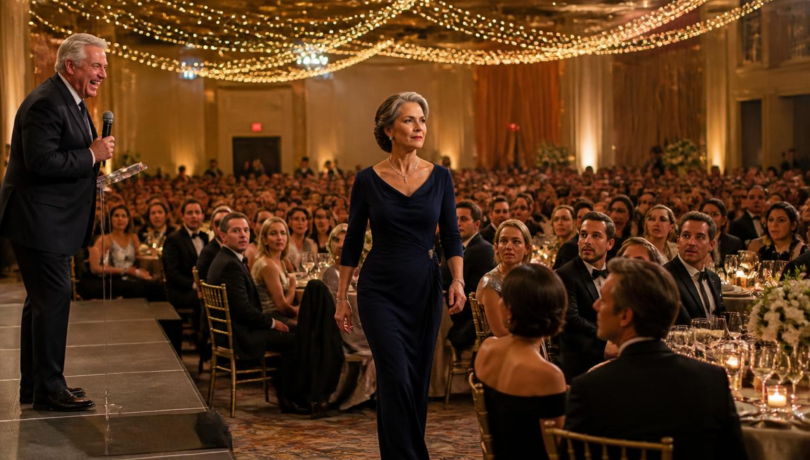
Douglas stood at the lectern with a glass of champagne raised high. His tie was loose around his neck, his face pink from the room's heat. He looked happy in a way I hadn't seen from him in months.
"Thirty-four years at Halvorsen," he said into the microphone, his voice loud and warm. The room quieted to listen. Three hundred people turned their chairs slightly toward him.
He grinned before he even finished the sentence, like he already knew the laugh was coming.
The First Line
"Thirty-four years at Halvorsen," he said again, "and I've only got one regret." He paused, letting it sit. "And she's sitting at table one, in the blue dress."
Laughter rolled through the room, quick and easy. A few people turned to look at me. I kept my hands still on my handbag and did not smile.
Nicholas leaned toward me. "He's kidding," he whispered. "Relax, Mom." I did not answer him.
Slower, This Time
Douglas lifted the glass higher, like he wanted to make sure everyone heard the next part clearly. He looked straight down the room at me, past three hundred heads.
"My wife," he said, slower now, each word spaced out, "is my biggest regret."
The laughter came again, bigger this time, rolling all the way to the back tables. Someone near the bar clapped. I felt my chair scrape back before I decided to stand.
Standing
Nicholas's hand shot out and caught my wrist. "Mom, sit down, it's a joke," he said, low and fast. I looked at him and pulled my arm free, gently.
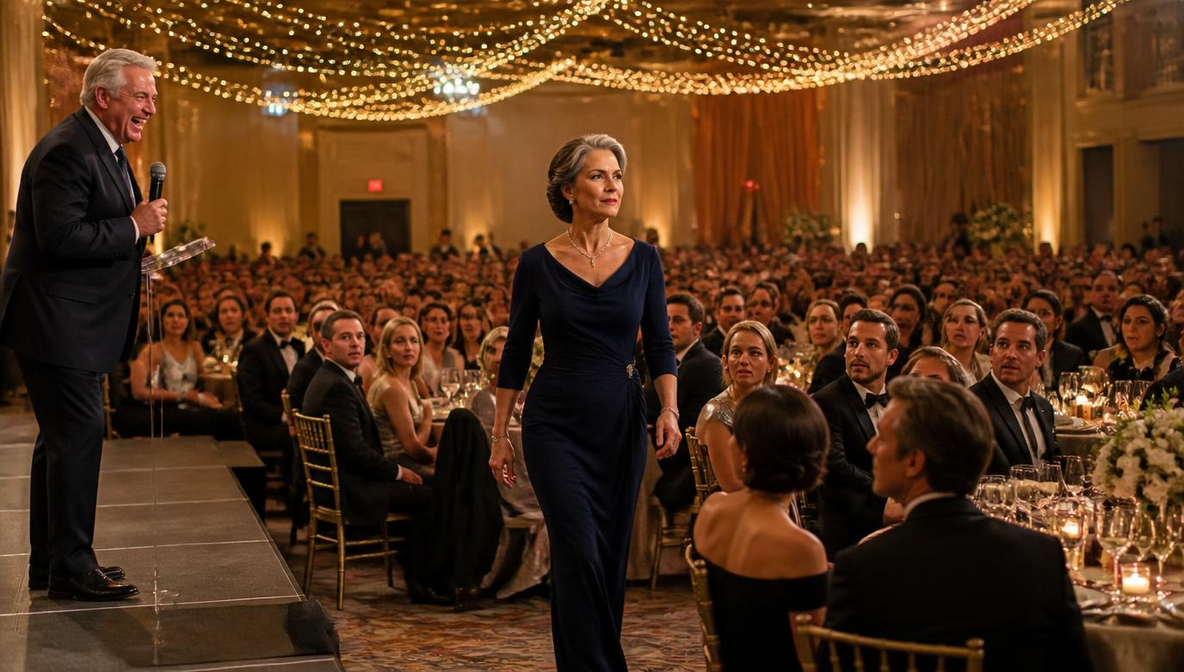
I stood up with my handbag against my hip. The room was still laughing, tables of it, waves moving further back as the joke passed mouth to mouth.
I started walking toward the lectern while the sound was still going, before anyone had stopped to notice I had moved.
Down the Room
I walked past table four, where a silver-haired man in a dark suit watched me over his water glass. I didn't know his name yet. He did not look surprised.
The laughter thinned out table by table as I passed, people turning to see what I was doing, forks stopping halfway to mouths.
Douglas did not step back from the microphone. He watched me come the whole way, his glass still raised, his smile steady like he had been waiting for exactly this.
The Open Arm
When I was close enough, he opened one arm out toward me, like I was a guest he had invited up. The gesture was warm. It looked, to the room, like love.
"Folks," he said into the microphone, "I think my wife has something she wants to say."
He held the microphone out toward me with two fingers, the cord swinging slightly. His face did not change. He looked ready for whatever I was about to do.
Reaching the Lectern
I stopped a few feet from him instead of taking the microphone. The room had gone quiet enough now that I could hear the ice machine behind the bar.
I looked down at the lectern instead of at him. There was a small stack of note cards near the edge, the kind used for short remarks, squared off and neat.
One card sat apart from the rest, face up, closer to where his hand had been resting.
The Card
The card was plain white, the edges crisp, like it had just come out of a fresh pack. Black typed letters sat centered on the front, no handwriting, no crossed-out words.
I read it once before I let myself understand it. MY WIFE IS MY BIGGEST REGRET. Typed, not scribbled, not a note to himself in the middle of a speech.
I picked it up. The room stayed silent, three hundred people watching me hold a small white card like it weighed something.
Turning It Over
I turned the card over in my hand without thinking, the way you check the back of anything that surprises you. There was ink there too, blue ballpoint, small and neat.
A date, written in his handwriting, the numbers slanted the way they always slanted when he wrote fast. Ten days before tonight.
I stared at the date until the numbers stopped looking like numbers and started looking like proof.
Ten Days
Ten days before this cake, before this slideshow, before this room full of people who worked with him for thirty-four years, he had sat somewhere and typed this line on a card.
He had written a date on the back of it, in his own hand, like he wanted a record of when the idea was born.
This was not a joke that slipped out of him. This was a line he had planned, carried, and waited to use.
His Face
I looked up at Douglas. He was still smiling, still holding the empty space where the microphone had been, waiting for me to take it from him.
His eyes were steady on my face, not nervous, not sorry. He looked like a man watching something go exactly the way he wanted.
"Go on," he said quietly, just for me, though the microphone still caught it and threw it into the room.
What the Room Saw
Three hundred people were watching a wife hold a card at her husband's retirement party, unsure if this was still the joke or something else now. Somewhere a fork clinked against a plate.
Nicholas had come halfway out of his seat at table one, frozen there, not sure whether to come closer or stay back.
The silver-haired man at table four had set his water glass down completely and was watching me with the kind of attention that had nothing to do with curiosity.
What I Knew
I knew three things standing there with that card in my hand. I knew he had planned this line for ten days. I knew my handbag held two filed copies of paperwork from three days ago. And I knew, looking at his face, that he was not embarrassed by any of it.
He wanted this. He had built this moment on purpose, the way you build anything you intend to use.
Whatever came next in this room, he had already decided how it would go.
Taking the Microphone
I set the card down flat on the lectern and reached for the microphone myself. Douglas let it go easily, almost gently, like he had been holding it out for me the whole time.
The cord was warm from his hand. I turned to face the room, three hundred faces waiting, some still smiling from the joke that had not landed the way they expected.
I opened my handbag with my free hand and felt the folded papers inside it, sharp-edged and real.
The Paper
I pulled out the folded papers with the microphone still in my other hand. They were warm from being pressed against my side all night.
The room stayed quiet, waiting to see what I would do with them. I unfolded the top sheet slowly, my fingers steady even though my chest wasn't.
"I filed for divorce three days ago," I said. My voice came out clear, louder than I expected.
The Second Paper
I held up the second sheet next to the first. "I also filed a fraud complaint," I said. "Same day. Same courthouse."
A murmur moved through the tables, low and confused. Someone near the back said "what" out loud, not quiet enough to hide it.
I looked down at the stamp in the corner of both pages, the blue ink pressed hard into the paper.
The Stamp
"Time stamped 11:14 in the morning," I said. "Last Tuesday." I read the case number off the divorce petition first, then the number on the fraud complaint.
I said both numbers slowly, the way Priya had told me to say things I wanted people to remember. My hands did not shake while I read them.
The room had stopped laughing completely now. Nobody at any table was smiling anymore.
Silence
Three hundred people sat in a silence that felt heavier than the laughing had. Nicholas was standing now, all the way up, his face pale under the ballroom lights.
I looked past him toward the man at table four. He hadn't moved. His eyes were fixed on me like he was waiting for something specific.
I didn't understand yet why a stranger would care this much about what I had just said.
Douglas Leans In
Douglas didn't step away from me. He leaned toward the microphone I was holding, close enough that his voice would carry even softer than mine had.
"Tell them the account," he said. His tone was calm, almost kind, like he was helping me finish a sentence I'd started.
I looked at him, confused for a second by how easy the words came out of him. He nodded once, like he was giving me permission.
Saying It
I don't know why I said it. Maybe because I had practiced the whole speech in my head for three days and this felt like the next line.
"The account is registered to Voss Heritage Holdings," I said, and then I gave the number, digit by digit, into the microphone.
The room caught every syllable. I heard someone repeat it under their breath at a nearby table, like they were writing it down in their head.
Thank You
Douglas exhaled, slow and easy, like he'd been holding his breath the whole toast. "Thank you," he said, quiet, just to me.
He said it the way you thank someone for handing you something you'd been reaching for. Not sorry. Not surprised. Grateful.
I stood there holding two pieces of paper and an empty feeling I couldn't name yet, watching his face settle into something like relief.
The Glass
Douglas turned slightly away from me, toward the room, and lifted his half-empty champagne glass. He wasn't looking at me anymore.
He was looking at table four, straight at the silver-haired man in the dark suit, the one who had watched me the whole walk down the room.
The man lifted his own glass back, just an inch, just enough to answer him, and I still didn't know his name.
Monday Morning
The letter came with the regular mail, wedged between a grocery flyer and a light bill. I almost set it aside without looking twice.
The envelope had a bank logo in blue ink on the corner. My name was typed across the front, nothing else. Francesca Voss.
I opened it standing at the kitchen counter, still in my robe, coffee going cold beside me.
The Notice
The letter said the account was restrained, effective immediately. It named Voss Heritage Holdings LLC in bold type near the top.
Below that, one line stopped me cold. Francesca Voss, sole managing member.
I read it three times before the words held still. This was supposed to be his account. I had spent eight months proving that.
Calling Priya
I called Priya before I finished my coffee. My hands were steady enough to dial, but my voice wasn't.
"It says I'm the sole managing member," I told her. "How is that possible? I never opened anything."
There was a pause on her end, longer than usual. When she spoke again, her voice had changed, careful now, slower than before.
Priya's Voice
"Francesca, I need you to bring me everything you have," she said. "Every page. Today if you can."
She wasn't brisk anymore, the way she'd been when we filed. She sounded like someone reading a map that no longer matched the road.
"What does this mean?" I asked her. She didn't answer that part. She just asked me again to come in.
Groceries
Douglas showed up that afternoon with two paper bags of groceries, like nothing had happened three nights ago. He set them on the counter and started putting things away.
"Thought you'd need milk," he said, not looking at me. "And that bread you like."
I stood in the doorway watching him move through my kitchen like a man who still lived there. He hadn't asked if he could come in.
The Guest Room
That night he slept in the guest room without me telling him to. He carried his own pillow down the hall like it was already decided.
Nicholas stayed for dinner, quiet, picking at his plate. Douglas was gentle with him, asked about work, refilled his glass.
"Your mother's seemed tired lately," Douglas said to Nicholas, like I wasn't sitting right there. "I worry about her."
In Front of Nicholas
Nicholas looked at me across the table, unsure what to do with that. I felt the weight of it land somewhere behind my ribs.
"I'm fine," I said. My voice came out smaller than I wanted it to.
Douglas smiled at me, warm and easy, the same smile from the lectern. "Of course you are," he said. Nicholas nodded slowly, like he believed him.
After He Left
Douglas said goodnight and went down the hall to the guest room like he had every right to be there. I sat at the table a long time after Nicholas left.
I thought about the letter still folded in my handbag. Sole managing member. My name, typed clean, no mistake in it.
I got up and dug the bank letter out, spreading it flat on the table under the kitchen light.
Reading It Again
I read the letter one more time, slower now, my finger tracing each line. The account number matched the one I'd said into that microphone.
Everything matched. My name. The account. The company. On paper, it was mine, clean and legal, like it had always been mine.
I turned the page over, looking for anything I'd missed the first three times.
The Date
Near the bottom, in smaller print, there was a line I hadn't noticed before. Account opened, it said, followed by a date.
I stared at it, doing the math in my head without meaning to. Eight months before I'd found any of this. Eight months before I'd ever taken a single photograph of a bank statement.
I had been documenting an account that already had my name on it before I'd started looking.
Priya's Office
Priya's office had a window facing the parking lot. I sat across from her with the binder open between us, the one I'd built for eight months.
She had a new document laid flat on her desk. It was thicker than a letter, stapled at the corner, eleven pages long.
"This came from the bank's file," she said. "You need to see it before we talk about anything else."
The Cover Page
The cover page said Voss Heritage Holdings LLC, Operating Agreement, in plain black type. Below that, a date I recognized right away.
It was the same date as the account opening. Eight months before I'd ever taken a photo of a statement.
I flipped past the cover page slowly, already feeling something tighten in my chest before I understood why.
Page by Page
Each page had a small mark at the bottom corner. Two letters, pressed close together, in blue ink.
F.V. My initials, small and neat, the way I always wrote them when someone handed me something to sign quickly.
I turned page after page, and the same mark waited at the bottom of every one, all the way through page ten.
Page Eleven
Page eleven was different. It had a full signature line near the bottom, my name written out in full, Francesca Voss.
Next to it sat a raised stamp, the kind that leaves a shadow in the paper when you run your thumb over it. A notary seal.
I pressed my finger against the stamp and felt the small ridges of it, real and permanent.
Counting
I sat back in the chair and thought about every page Douglas had ever set in front of me. In kitchens. In hospital parking lots. Between errands.
He always said the same thing. Just initial here. I'm in a hurry. I never read them, not really, not all the way through.
I tried to count how many times that had happened over thirty-four years and gave up somewhere past a hundred.
Priya's Question
"Do you remember signing this?" Priya asked, tapping page eleven with one finger. Her voice was gentle now, careful in a way it hadn't been before.
I looked at the signature again. It was mine. The loops, the slant, the way I crossed my F. I couldn't say it wasn't.
"I don't remember this specific page," I said. "But that's my writing. I know my own writing."
What It Meant
"Then legally," Priya said, "this document is real. You signed it. It was notarized. As far as the law is concerned, you formed this company yourself."
I felt the binder under my hand, all eight months of photographs and notes I'd taken believing I was building a case against him.
Now it looked like something else. Like I had built the case against myself and handed it over with my own two hands.
Home Again
I drove home with the copy of the agreement folded on the passenger seat. Douglas's car was already in the driveway when I pulled in.
He was in the kitchen again, unpacking another bag of groceries like this was still his house, still his kitchen, still his life to arrange.
"Nicholas is coming by later," he said, not turning around. "I told him you had a doctor's appointment Thursday."
The Appointment
"What appointment," I said. I hadn't made any appointment. I hadn't been to a doctor in months.
"Neurology," Douglas said, like it was nothing, like he was mentioning the weather. "Dr. Amrit Sarin. Ten a.m. I already called."
I stood there staring at the back of his head while he folded an empty grocery bag in half, in half again, careful and slow.
Nicholas Arrives
Nicholas came in through the garage door twenty minutes later, dropping his keys on the counter the way he had since he was sixteen.
"Dad says you've been forgetting things," he said, not quite looking at me. "Like whole conversations. He's worried."
I opened my mouth to say I hadn't forgotten anything, and then I thought about page eleven, my own name, my own handwriting, and I said nothing at all.
The Emails
Douglas pulled out his phone and set it on the table, turned toward Nicholas. "I've been keeping notes," he said. "For almost a year now."
He opened an email folder and scrolled through it. Dozens of messages, all sent to himself, all dated over the last eleven months.
Subject lines like Fran forgot dentist again and Fran asked me the same question twice today. A whole year of proof, written by no one but him.
Reading Over His Shoulder
I leaned over and read a few of them while Nicholas watched my face instead of the screen. The dates were spread out evenly, almost too evenly, like a schedule.
Some of the things he described had never happened. I remembered every dentist appointment I'd ever had. I remembered every question I'd ever asked twice, and I hadn't.
But there they were, typed clean, sent to himself, timestamped and searchable, ready to be printed out for anyone who asked.
What I Said
"I didn't write any of that," I said quietly. "I don't know what he's talking about."
Nicholas looked between us, his jaw tight, his eyes moving from his father's calm face to mine. He didn't know who to believe.
"Mom," he said finally, "maybe it wouldn't hurt to just see the doctor. Just to rule things out."
After They Left
Douglas took Nicholas out for dinner that night, the two of them talking easily in the driveway before they drove off. I stood at the window and watched the taillights disappear.
I went back to the kitchen table and spread page eleven out flat again under the lamp. I looked at the notary stamp one more time, hard, trying to place the name pressed into the seal.
I found a small line of type below the stamp, the notary's printed name and commission number, and something about it looked wrong.
The Name
I got my laptop and searched the name from the stamp, along with Halvorsen Freight, just to see what came up.
The first result was an old company newsletter, four years old, with a photo of a smiling woman at a retirement lunch. Same name. Same face, younger, in the photo.
She had retired from Halvorsen four years before this agreement was ever signed, four years before she supposedly stamped my name into something real.
The Notary Who Wasn't There
I sat with the laptop open a long time, looking at that photo of a smiling woman at her own retirement lunch. Her name matched the stamp on page eleven exactly.
She had left Halvorsen four years before the agreement was even dated. She couldn't have stamped anything in this house, on this table, ever.
I closed the laptop and sat in the quiet kitchen, listening to the fridge hum. Somebody had used her name the way Douglas used mine.
The Parking Garage
Priya asked me to meet a woman named Renata in a parking garage downtown, second level, by the elevator. She wouldn't say more on the phone.
I recognized her from the slideshow at the party, standing near Douglas in an old company photo. Renata Kroll, his assistant for eleven years.
She held out a small black thumb drive without saying hello first. "You need to see what's on this before you go home tonight," she said.
In the Car
I plugged the drive into my laptop right there in the driver's seat, engine off, garage lights flickering above me. A folder opened with three files inside.
The first was a Word document named TOAST. I clicked it and the text filled the screen, line by line, familiar and awful.
My wife is my biggest regret. The same words from the card. Saved, according to the file details, ten full days before the party.
The Text Thread
The second file was a screenshot of messages between Douglas and a number saved as Reddick. I scrolled slowly, reading each line twice.
She'll say it herself, on the record, in front of the whole company, one message said. Then it's her complaint, her account, her name, the next one read.
I sat with my hands on the wheel, not moving, watching my own name sit inside someone else's plan like it had always belonged there.
Reddick
I finally had a name for the silver-haired man at table four. Alan Reddick. I searched him on my phone right there in the garage.
Halvorsen's chief financial officer, the page said, next to a photo of him shaking Douglas's hand at some company dinner years back.
I remembered his face over the water glass, watching me walk the length of the ballroom. He hadn't been surprised. He'd been waiting.
The Recording
The third file was a video, longer than the others. Renata had said Bettina, the banquet manager, kept three cameras running on the room that whole night.
I watched myself stand up at table one, small and far away on the screen, my handbag against my hip the whole walk down.
Then the camera cut to a closer angle, right on Douglas's face while he said the line into the microphone the second time, slower.
Where He Looked
I paused it and looked hard at his eyes in that frame. He wasn't looking down the room at me in the blue dress.
He was looking at table four. Straight at Reddick, the same way you check with someone before you start something you've already agreed on.
I hadn't caught it live, standing so far away. On the screen, frozen, it was the clearest thing in the whole video.
After the Account Number
I watched myself say the account number into the microphone, digit by digit, my voice steady on the recording in a way I didn't remember feeling.
Then I watched Douglas turn from me, his face relieved, exactly like it had felt standing next to him.
He lifted his glass toward table four. Reddick lifted his back, just an inch, and the whole exchange lasted maybe two seconds.
Watching It Again
I played that part three more times, my finger on the trackpad, going back to the same two seconds over and over.
It wasn't a joke that got out of hand. It wasn't a husband forgetting himself in front of a crowd. It was timed.
He had built the whole toast around getting me to that microphone, and I had walked up there and said every word he needed.
What I Was
I sat back against the car seat and let that settle. I hadn't been the target of that insult at all. I had been the tool for it.
Three hundred people had watched me hand him exactly what he wanted, on a live microphone, with case numbers and an account number attached to my own voice.
He hadn't needed to convince a jury of anything. I had done it myself, out loud, in front of witnesses he'd invited on purpose.
Douglas Calls
My phone rang before I could close the laptop. Douglas's name lit up the screen. I let it ring twice before I answered.
"I was thinking," he said, his voice soft, almost tired, "maybe you should come home tonight. Sleep in our bed. This has been hard on both of us."
I looked at the frozen frame still on my screen, his glass raised toward Reddick, and said nothing for a moment.
What He Didn't Know
"I miss you, Fran," he said, and it almost sounded true, the way it always had. "We built a life together. Let's not throw it away."
I thought about the TOAST file saved ten days early, the text thread, the two seconds of glasses lifting toward a man I hadn't known by name three days ago.
"I'll think about it," I said, and hung up before my voice could give anything away.
Priya's Reaction
I drove straight to Priya's office instead of home, the thumb drive in my coat pocket the whole way. She watched the video twice without speaking.
When it ended, she sat back in her chair and rubbed her eyes under her glasses. "This changes everything," she said. "This isn't just a marriage falling apart."
"He planned it," I said. "He needed me to say it. On the record. In front of everyone."
The State Already Knew
Priya opened a folder on her desk I hadn't seen before, pages clipped together at the corner. "There's something else," she said. "I got a call this morning."
"The state financial crimes unit has a file open," she said. "They've had it for weeks. Before the party. Before any of this."
I stared at her, not understanding at first. "A file on who," I asked, already afraid I knew the answer before she said it.
My Name
"On you," Priya said quietly. "Someone gave them your name as the person to look at. Weeks before you ever stood up at that microphone."
I thought about the account number I'd said out loud, clear enough for three hundred people to hear and repeat. I thought about page eleven, my full signature, real ink.
Whoever built this hadn't waited for the party to name me. They'd already put my name in front of the people who could take everything away.
The Target Letter
Priya slid one more page across her desk. It had a state seal at the top and my name in bold letters. Subject: Francesca Voss.
She said it came stapled to something bigger, a cooperation agreement Douglas signed weeks before the party. His signature was on every page.
I read the date on his agreement twice. Five weeks before he stood at that lectern smiling at me.
Five Weeks Before
Five weeks before the cake and the slideshow, he had already sat in a room and signed his name to something with mine attached. He knew exactly what was coming.
The party wasn't the start of anything. It was the middle of a plan he'd already put in writing with the state.
I thought about him lifting his glass toward Reddick and felt something in my chest go cold and steady at the same time.
The Sentence
Near the bottom of his statement, one line was underlined in pencil, not by me. At my wife's direction, it said.
I read it three times, the way I'd read the bank letter, waiting for the words to rearrange into something that made sense.
"He's telling them I ran this," I said out loud. Priya didn't answer right away. She just watched my face.
What I Stopped Defending
I sat back in the chair and realized I wasn't thinking about our marriage anymore. I wasn't thinking about thirty-four years or the guest room or the groceries.
I was thinking about my own name, sitting in a state file, attached to a sentence he wrote to save himself.
"I don't want the marriage back," I said. "I want my name back. That's different now."
Calling Okafor
Priya gave me a number that afternoon, a state investigator named Dale Okafor. She said he'd been assigned the file weeks ago, before any of this became public.
I called him from my car in the parking garage, the same spot where Renata had handed me the drive.
His voice was flat and careful, a man used to people lying to him. "I've read your file, Mrs. Voss," he said. "I have some questions for you too."
Meeting Okafor
We met at a small office downtown, gray walls, a folder already open on the table between us. He didn't smile when I sat down.
"Your husband's cooperation agreement names you as the person who directed this," he said. "I need to know if that's true."
"It's not," I said. "I have proof it's not." I set my binder on the table, eight months thick, and watched his eyes move over the cover.
The One Thing I Asked For
He didn't promise me anything. He said the file was still open, that my name being cleared wasn't something he could hand me on the spot.
"There's one thing you can still get me," I said. "The notary who stamped page eleven. She retired four years before that date. I need her name confirmed, official."
He wrote something down and didn't look up. "I can pull that," he said. "Give me a few days."
Douglas Moves Out
I came home two days later to find half the closet empty. Douglas's suits were gone, his side of the bathroom counter bare.
He'd left a note on the kitchen table, short and calm, saying he'd found a rental nearby and thought it was best for now.
He wrote that he didn't want to make things harder on me while I was going through so much. Like he was doing me a kindness.
The Rental
I drove past the address once, a small brick building near the highway, nothing like our house. His car sat in the lot, clean and parked straight.
He called that night, his voice gentle, worried-sounding. "I just want you to get some rest," he said. "You don't need me making things worse."
I asked him about the cooperation agreement, about the sentence with my name in it. He went quiet, then said he had to go, someone was calling him.
Stops Answering
After that he stopped picking up when I called. My texts sat there unread for hours, sometimes a whole day, then a short reply that answered nothing.
Nicholas told me his father was staying strong, being patient, trying not to upset me further. He said it like he believed every word.
I looked at my phone, at the last message Douglas sent, just okay, take care, and felt the distance land on me all at once.
Okafor's Call
Okafor called four days later, his voice a little different, less flat than before. "I pulled the notary's record," he said. "You were right. She retired in 2020."
"She never worked in your husband's building after that," he said. "She couldn't have stamped anything at your table in 2021."
I sat down on the edge of my bed, the phone pressed hard against my ear, waiting for whatever came next.
What Comes Next
"I need everything you have," Okafor said. "All of it. Your binder, the drive, whatever else you're holding onto."
I told him I'd bring it in the morning. He said one more thing before he hung up, almost gentle for a man who didn't do gentle.
"You should know," he said, "your husband's statement isn't just about you. There are other names in it. Page four, especially."
Page Four
I asked Priya to pull a copy before I went in. She found it that same afternoon, four pages stapled together, his signature at the bottom of each one.
Page four listed a transfer, dated and numbered, moved out of the LLC account into another one entirely. Executed by, it read, Nicholas Voss.
I stared at our son's name typed clean into a state file, sitting there next to a dollar amount I didn't want to read twice.
Reading It Alone
I sat at my kitchen table with the page flat in front of me, the same table where Douglas had unpacked groceries like nothing was wrong.
Nicholas had a license. A career. A father who'd told him it was just paperwork, just a transfer, just following instructions.
I thought about every time Douglas had said the same thing to me. Just sign here. I'm in a hurry.
What I Understood
I understood then that Douglas hadn't just used my signature. He'd used our son's job, our son's name, our son's trust in him, the same way.
He'd built a whole structure out of the people who loved him most, and none of us had thought to ask why he was always in such a hurry.
I folded page four back into the file and sat there a long time before I could make myself pick up the phone.
The Hall Closet
I couldn't sleep after reading page four, so I went looking for anything that might explain it. The hall closet held old files we never threw away, tax papers, warranty booklets, things from years back.
I pulled down a tan folder marked 2019 REFINANCE in Douglas's handwriting. I remembered that year. We'd talked about lowering the mortgage rate, nothing more than that.
I sat on the hallway floor and opened it under the light, not expecting to find anything strange.
Blank Pages
Inside were eleven sheets of paper, each one blank except for a signature at the bottom. My signature, over and over, the same loops, the same slant.
No text above any of them. No loan terms, no bank name, no numbers. Just my name, waiting for someone to fill in whatever they wanted above it.
I counted them twice, laying them flat across the carpet, eleven pages of nothing with my name signed at the bottom of each one.
Where I Remembered Signing
I sat back against the closet door and tried to remember signing these. Nothing came clear, no single moment, just a blur of years.
Then I remembered a night in a hospital lobby, Douglas handing me a clipboard, saying paperwork for the refinance, sign here, I'll explain later.
I remembered saying I hadn't read it. He'd said it was fine, standard stuff, nothing to worry about. I signed because he was in a hurry.
The Courier Envelope
Under the blank sheets sat a courier envelope, the kind with a tracking sticker on the front. The date on it stopped me cold.
It matched the week our grandson was born early, the week he spent in the NICU, tubes and monitors, all of us barely sleeping.
I remembered signing something in the hospital parking lot that same week, Douglas leaning into my car window, saying it wouldn't take a minute.
What He Took That Week
I sat with the envelope in my lap, picturing myself in that parking lot, exhausted, half listening, signing whatever he put in front of me.
He'd picked that week on purpose. He'd known I wouldn't read anything closely, wouldn't ask questions, wouldn't have room in my head for paperwork.
He'd used the worst week of my life to collect something he needed, and I hadn't even noticed him doing it.
Counting Years
I thought back further, past 2019, trying to count every time he'd handed me something with the same words. Just sign here. I'm in a hurry.
Driveways before work. Waiting rooms. The kitchen table at midnight while I was half asleep. Every blank page a small theft I hadn't noticed happening.
I couldn't count them all. There were too many years, too many rushed mornings, too many times I'd trusted him without looking down at the page.
The Phone Rings
My phone buzzed on the carpet next to me while I was still holding the envelope. An email notification, subject line marked Settlement Offer, sender a law firm I didn't know.
I opened it standing up, my legs stiff from sitting on the floor so long. Douglas's name was listed as the client at the top.
I scrolled down slowly, reading each line twice, trying to understand what was being offered and why now.
The Offer
The letter said Douglas would sign the house over to me completely, free and clear, no argument, no fight over it.
The condition sat in the second paragraph, plain and simple. In exchange, I would agree not to speak with investigators or provide further documents to the state.
I read that sentence three times, the house dangled in front of me like something I should want more than the truth.
What the Offer Told Me
I sat down at the kitchen table with the phone still in my hand, thinking about what it meant that he'd offer me anything at all.
A man who believed I knew nothing wouldn't need to buy my silence. He'd only do this if he was afraid of what I already had.
The offer wasn't kindness. It was proof that Okafor's file, my binder, all of it, was starting to matter to someone who used to feel safe.
Calling Priya
I called Priya and read her the offer word for word. She was quiet for a moment before she answered.
"Don't respond yet," she said. "This tells us he's scared. Scared people make offers like this. Don't sign anything, don't say anything back."
"I found something else," I told her. "Eleven blank pages with my signature. From 2019. I think I know how he did all of it."
Bringing the Folder In
I drove the folder to her office the next morning, the courier envelope tucked inside it, careful not to bend the corners.
She spread the blank pages across her desk, counting them the same way I had on the closet floor, slow and quiet.
"This is the mechanism," she said finally. "He collected blank signatures for years. Then someone typed whatever they wanted above them, whenever they needed it."
Comparing the Pages
Priya pulled the LLC operating agreement out of my binder and laid it next to the blank sheets. She started matching paper weight, matching the slant of my signature, page by page.
"These match the paper stock from the agreement," she said, holding two sheets up to the light. "Same brand. Same batch, maybe."
I watched her line up the signatures side by side, mine on the blank page, mine on page eleven of the agreement, identical in every way that mattered.
My Own Copy
That night I went looking for my own copy of the 2019 refinance, the one I remembered filing away years ago in a drawer upstairs.
I found it in a folder marked Mortgage, thinner than I remembered, the pages inside numbered neatly in the corner.
I flipped through it slowly, checking the numbers against each other, one through however many pages the loan had run.
Two Missing
Two page numbers were gone. Page six and page nine, skipped clean, the rest of the document jumping right past them like they'd never existed.
I sat there staring at the gap, my finger tracing the space where those pages should have been, wondering what had been on them.
I thought about the LLC agreement still sitting in Priya's office and felt something cold settle low in my stomach.
Matching the Numbers
I grabbed my phone and called Priya even though it was late. "Check the LLC pages," I said. "Pages six and nine. See what's on them."
She was quiet for a moment, papers shuffling on her end of the line. Then she read them back to me, slow and careful.
Page six of the operating agreement held the ownership terms. Page nine held the wire authorization language. The exact two pages missing from my own copy of the refinance.
The Notary's Name
I found her name on page eleven again, printed clean under the seal. Joyce Fenner, commission number, an address on file with the state.
Okafor had confirmed she retired in 2020. That still didn't explain how her stamp ended up on a document dated 2021, in a house she'd never visited.
I asked Priya to find where Joyce lived now. It took a day. A small house on Larkspur Street, forty minutes from mine.
Larkspur Street
The house was small and neat, a wheelchair ramp built over the front steps. A wind chime hung by the door, quiet in the still afternoon air.
I sat in my car a long time before I got out. I didn't know what I was walking into, or what she'd say when she saw me.
I knocked twice. It took a while before I heard someone moving slow behind the door, a cane tapping against the floor.
Joyce
She opened the door a crack first, chain still on, one eye peering out at me over wire-rimmed glasses. "Can I help you," she said, careful, not unkind.
"I'm Francesca Voss," I said. Her face changed the second she heard the name. She didn't open the door any wider.
"I know who you are," she said quietly. "I've been waiting for someone to come ask me about this."
Inside
She let me in slow, leaning hard on her cane, leading me to a small kitchen table with a lace cloth on it. She didn't offer tea. She just sat down across from me and folded her hands.
"I retired in 2020," she said, before I could ask anything. "I haven't notarized a single page since."
"Then how is your stamp on a document from 2021," I said. She looked down at her hands and didn't answer right away.
The Shoebox
She got up without a word and shuffled to a hall closet, pulling down a shoebox from the top shelf. She set it on the table between us like it was heavy.
"I kept a journal," she said. "Every notary is supposed to. Forty-one years of them, in boxes like this one." She lifted the lid and pulled out a worn cloth-bound book.
"I never threw them away," she said. "Even after I stopped working. Some habits don't leave you."
March 14
She flipped through the pages slowly, her finger tracing dates until she found the one she wanted. March 14, 2021, written in her careful hand at the top of the entry.
The entry listed a name, Francesca Voss, and a document type, LLC operating agreement. Below that, an ID number for identification, a driver's license.
I read the number twice. It matched an old license, one I'd surrendered at the DMV in 2017 when I renewed. I hadn't carried that license in four years.
The Thumbprint Box
Next to the entry sat a small square marked Thumbprint, the way old notary journals required for certain documents. A smudge of ink sat inside the box, faint but there.
I held my thumb up next to it without thinking, comparing the size. Mine was wider, the ridges spread further apart than the print in the book.
"That's not my thumb," I said quietly. Joyce didn't argue. She just nodded like she already knew.
What I Could Not Write
I sat back in the chair, my hands flat on the table. Douglas could type an email. He could sign a company form. He could forge my initials on ten pages easily enough.
But he couldn't have made this entry. He couldn't have written Joyce Fenner's handwriting into her own private journal, kept in her own house, in a box she never let out of her sight.
This was the one thing that wasn't his. It was hers, and it proved someone had come to her pretending to be me.
Joyce's Fear
"He came alone," Joyce said suddenly, her voice thin. "Douglas. He told me his wife was waiting in the car, resting, that she wasn't feeling well enough to come in."
"I'd known him since Halvorsen," she said. "I did him favors for years. Notarized things after hours, off the books sometimes, because he asked nice and I trusted him."
She wouldn't look at me while she said it. Her hands shook a little on the edge of the journal.
What She Broke
"I never should have stamped it without you standing in front of me," she said. "I know the rule. I've known it forty-one years." Her voice cracked on the last word.
I didn't say anything cruel to her. I could see how scared she already was, sitting across from me with her whole life's journal open on the table.
"I need this book," I said gently. "The state needs to see it. I know what that means for you."
Before I Could Take It
My phone rang in my bag before she answered. Douglas's name lit up the screen. I let it ring, watching Joyce's face go pale at the sound.
"He calls me sometimes," she said. "Still. Checks in. Asks how I'm doing." I asked her if he'd called recently, this week, about anything specific.
She nodded slowly. "Yesterday," she said. "He reminded me of all the favors over the years. Asked if I remembered them fondly."
What He Asked Her
"He didn't threaten me," she said, like she needed me to understand that part. "He just talked about the old days. Halvorsen Christmas parties. How loyal I'd always been."
"Then he asked if I still had my old journals," she said. "I told him no. I lied to him." Her hands were still shaking a little.
I understood then that Douglas was already moving, already trying to close this door before I found it open.
The Motion
Priya called that evening while I was still driving home, Joyce's shoebox belted into the passenger seat like a person. "Douglas's lawyer filed something today," she said.
"A motion asking the court to order a competence evaluation," she said. "For you. Says you've shown signs of memory issues, confusion, that you may not be fit to handle your own affairs."
I gripped the wheel tighter, thinking of the emails he'd sent himself, the neurologist appointment, all of it lining up like it had been built for exactly this moment.
Telling Priya
I pulled over to tell her about Joyce, about the journal, about the thumbprint that didn't match mine. She was quiet on the other end, then let out a breath.
"That's real," she said. "That's the one thing he couldn't have faked himself. If Joyce will hand it over, it could undo everything he's tried to build."
"She's scared," I said. "She broke the rule to help him. She's seventy-four. She doesn't want trouble."
Back at the Table
I drove back to Larkspur Street the next morning instead of going home. Joyce was already at the table, the journal still sitting where I'd left it the day before.
"I've been thinking," she said before I could speak. "About the day he came. There was someone else with him. Waiting in the hallway by my door."
I asked her who. She frowned, trying to remember, her fingers pressed against her temple like the memory was hard to reach.
The Young Man
"A young man," she said slowly. "Nice suit. Didn't come inside. Just stood there in the hall the whole time, looking at his phone." She hadn't thought much of it back then.
I felt my stomach turn over slow and heavy. Nicholas had worn a suit like that for years, ever since he started his job.
I didn't ask her his age or his hair color. I already knew, in the quiet way you know things you don't want to.
Okafor's Office Again
I asked Joyce not to worry, that I'd call her before anyone came to her door. Then I drove straight to Okafor's office with the shoebox on my lap the whole way.
He read Joyce's entry twice, then studied the thumbprint under a small lamp on his desk. He didn't say much, just nodded once and wrote something down.
"This is the piece we needed," he said. "But I have to tell you what taking it means. All of it. Not just the good parts."
What He Meant
He slid a folder across the table, my name typed at the top. Cooperation Agreement, it said, in the same plain type as Douglas's had been.
"If you sign this," he said, "you're giving us everything. The binder, the journal, the drive. Every page, every name that's in any of it."
I asked him what that meant for Nicholas. He didn't soften it. "His name is already in the file," he said. "Page four."
Page Four Again
He turned to the page and pushed it toward me. Nicholas Voss, it said again, next to the wire transfer, the dollar amount typed clean beside it.
Below that was a line for my initials, right next to my son's name, confirming I understood he was a person of interest.
I stared at the blank line a long time. My pen sat on the table between us, waiting for me to pick it up.
Reading Every Word
I didn't sign it right away. I asked Okafor to give me a minute, and he stepped out into the hallway without arguing.
I read the whole agreement start to finish, every clause, every line, the way I never had with anything Douglas ever handed me.
I understood every sentence. For the first time in thirty-four years, I knew exactly what I was agreeing to before I agreed to it.
The Deposition
Three days later I sat across a long table from Douglas, lawyers on both sides, a court reporter typing quietly at the end. He looked smaller than he had at the party.
"Fran," he said, before his lawyer could stop him, "can we talk. Just us. One minute."
His lawyer started to object, but Okafor waved it through. The room went quiet, waiting to see what he wanted to say to me.
His Offer
"Take it all," he said. "The house, whatever's left in the accounts, I don't care anymore. I'll sign whatever you want."
He leaned forward, his voice low, almost pleading. "Just leave Nicholas out of it. He didn't know what he was doing. He trusted me."
I looked at him and, for the first time since the ballroom, I believed every word. It was the first honest thing he'd said to me in months.
What It Cost
I thought about it longer than I expected to. I thought about Nicholas as a boy, waiting in cars while we argued, running paperwork between us his whole life without knowing why.
I thought about page four, his name typed next to a number, sitting in a file that would follow him for years if I let it stay.
Then I thought about page eleven, my own name, forged and real at the same time, and what it had cost me to finally understand my own paper.
My Answer
"No," I said. My voice didn't shake. "I already signed the agreement. Everything goes in. His name stays where it is."
Douglas's face changed, the calm dropping off it fast. "Fran," he said, sharper now, "he's your son."
"He's a grown man who executed a wire transfer," I said. "I love him. That doesn't mean I get to erase what's true."
The Silence After
Nobody spoke for a moment. The court reporter's fingers had stopped moving on the keys. Douglas's lawyer put a hand on his arm, quiet, warning him off.
I looked at Okafor across the table. He gave me a small nod, the kind that meant he'd expected this answer, and maybe respected it.
Douglas sat back in his chair, jaw tight, the pleading gone out of his face completely. He didn't say anything else to me.
Nicholas Leaves
The door at the back of the room opened. Nicholas had been waiting outside with his own lawyer, close enough to hear through the wall.
He stepped in for a second, his face pale, his eyes moving from his father to me and back again. Nobody had told me he was there.
He turned around without a word and walked out, the door swinging shut behind him, and he never once looked in my direction.
The Plea
Priya called to tell me before I saw it on the news. Douglas had pled out. Fifty-one months, restitution, no trial.
"He tried to keep the cooperation deal," she said. "The state tore it up once they saw he wasn't a witness. He was the one running it."
I sat with the phone against my ear a long time. Fifty-one months felt like a number, not a punishment. Numbers don't fix anything.
Reddick
Reddick got more time than Douglas did. The judge called him the architect, the one who built the structure Douglas only signed his name to.
I read about it in the paper, a short article on page six, no photo of me anywhere in it. My name only showed up once, in a single sentence.
Francesca Voss, listed as a victim, cleared of any wrongdoing. Six words. That was all it took to undo a year of his emails.
The Letterhead
The state's letter came a week later, plain white paper with a blue seal at the top. One paragraph, nothing more.
It said the investigation into Francesca Voss had concluded. No charges. No further action. My name spelled right, my case number listed clean at the bottom.
I read it standing in my kitchen, the same counter where the bank letter had come months before. This one felt lighter in my hand.
Selling the House
The house sold that spring, most of the money going straight into restitution, the rest split by the court. What was left didn't stretch far.
I found a two-bedroom above a bakery downtown, second floor, a metal staircase up the side of the building. Rent I could just barely manage on my own.
The smell of bread came up through the floor every morning before six. I didn't mind it. It gave the mornings something to hold onto.
The Bakery Apartment
I unpacked slow, boxes stacked against walls that weren't mine yet. A window over the sink looked down at the alley where the delivery trucks parked.
Nicholas helped me move one box, the heaviest one, then left before I could ask him to stay for coffee. He didn't say much. He hadn't in months.
I set the box down in the corner and didn't open it that day. Some things I wasn't ready to unpack yet.
Nicholas
He pled to a misdemeanor for the wire transfer. Lost his broker's license, the thing he'd worked years to earn. He blamed me for it, quietly, in the way silence blames someone.
He calls now on Thanksgiving, on my birthday, short calls that end fast. He doesn't ask about the apartment or the bakery smell or how I'm sleeping.
I take what he gives me. I tell myself a phone call twice a year is still a door, even a narrow one.
Douglas's Letter
A letter came from the facility six weeks after he started his sentence. His handwriting on the envelope, smaller than I remembered it.
Inside he asked me to write the court, to tell them about the good years, the early ones, before any of this. He said I owed him that much, for thirty-four years.
I read it twice at my kitchen table, the same careful slant to every letter, still convinced someone owed him something.
My Answer
I didn't write to the court. I found a copy of Joyce's journal page instead, the March 14 entry, the thumbprint that wasn't mine.
I folded it into an envelope with no note attached, no explanation, nothing of my own words at all. I mailed it to the address on his letter.
I figured he already knew what it meant. He'd built the whole thing. He didn't need me to spell it out for him twice.
The Application
I filled out the state notary application myself, no one standing over my shoulder, no one telling me where to sign. I read every line before I wrote anything.
The test came a month later, easy compared to everything else I'd read that year. I passed it the first time, no surprise on my face when the results came back.
The certificate arrived in a plain envelope, cream cardstock, a raised seal at the bottom. My name printed clean across the middle. Francesca Voss.
The New Journal
I bought a plain dark journal from the office supply store two blocks from the bakery. Nothing fancy, just a bound book with blank lines waiting to be filled.
I set it on my kitchen table next to Joyce's shoebox, which she'd asked me to keep after everything settled. Two journals, one old, one new, side by side.
I opened mine to the first page and wrote the date at the top, careful, slow, the way Joyce must have done forty-one years ago.
The Index Card
Before I closed the cover, I slid the white index card underneath it, the one from the lectern. My wife is my biggest regret, still typed clean, still dated in his hand on the back.
I didn't put it there to remember him. I put it there to remember what it costs when someone else writes down your life for you.
The journal cover closed over it flat, the card hidden now, holding the whole book down like a weight.
First Entry
My first customer was a young woman signing a lease for her first apartment, nervous, her hand shaking a little over the line. I watched her sign, checked her license, matched the name.
I pressed my own stamp into the corner, the ridges catching the light the way Joyce's always had. I wrote her name into my journal, the date, the document type.
She thanked me on her way out. I sat there a minute after, looking at the page, my own handwriting filling the first line of something that was finally mine.
Watching Others Sign
That became the work of my days now, watching strangers put their names on paper, checking every line before I let them walk out the door. I never rush anyone.
I ask them to read what they're signing. I say it plain, every time, the way no one ever said it to me. Take your time. Read it first.
Some of them look surprised I'd bother saying it. I tell them I learned it the hard way, and leave it at that.
What Stays
I count the cost some nights, sitting by the window with the bakery smell rising up through the floor. A son who calls twice a year. A house that's gone. Money mostly spent on other people's mistakes.
I don't call it a fair trade. I don't think anything about it was fair. But I know my own name now, better than I ever did before.
Every week I say the same sentence to someone new, watching them sign their name for the first time in front of a witness. I ask them to please read it before they sign.


